


What if a steady stream of qualified leads could come from helpful information you already own?
This guide promises a clear path: turn attention into paying customers for a U.S. business using a repeatable content marketing approach.
You will get a step-by-step view from strategy to execution to measurement. Expect practical examples, metrics, and templates that work for local services, B2B, ecommerce, and professional firms.
We map the buyer journey — awareness → consideration → purchase — so each piece of content pulls an audience closer to a decision.
Think long-term: well-made content compounds. One asset can keep driving traffic, leads, and sales months or years after you publish.
This section sets an informational, action-first tone. Read on for templates and tests you can use this week to start turning attention into clients.
What Content Marketing Is and Why It Attracts Clients
Useful, targeted messaging is how businesses win attention and convert it into real relationships.
A practical definition: content marketing means creating and distributing valuable, relevant content for a specific audience — not posting randomly. The goal is to attract attention, generate leads, and guide visitors toward becoming customers.
Why “valuable” matters: useful material solves real problems, answers key questions, or lowers buying risk. When readers get practical help, they trust the company behind it.
“Repeated helpful guidance makes a business feel competent before any sales talk begins.”
Trust builds loyalty. People return to brands that educate and support them, and loyalty raises the chance of future purchases.
The modern shift is clear: many firms now act like a media publisher. That means editorial calendars, quality checks, and steady delivery — not one-off ads.
Core rule: choose formats and channels to earn attention with usefulness, then convert ethically. This work is ongoing and needs a documented strategy to stay measurable.

Why Content Marketing Matters for US Businesses Right Now
Buyers in the U.S. start their purchase journeys with searches and how-to videos long before they ever talk to a salesperson.
Visibility now comes from helpful answers, not interruptions. When potential customers look for solutions, useful pages and short video explainers appear in search and feed results. Those assets bring organic reach and social shares that outlast one paid ad.
Publishing specific, problem-solving material builds authority. Firms that explain common problems and show steps to fix them feel safer to hire than companies that stay silent.

Proof and practical effects
- Businesses with a blog get about 67% more leads than those without.
- Research shows 88% of people credit branded videos for helping them decide to buy.
- Nearly half of decision-makers plan to increase budgets, and 86% will maintain or raise spend into early 2024—an argument for steady investment.
Think of each blog post or video as a durable business asset. Update and re-share it, and it continues to drive traffic and leads over months or years. That durability explains why many marketers keep budgets steady or growing: buyers reward helpful, consistent work.
How Content Marketing Works Across the Buyer Journey
A staged approach gives each asset a role: teach, compare, then reassure.
Define the buyer journey simply: awareness → consideration → purchase. Mapping assets to those stages reduces wasted effort and raises conversion efficiency.
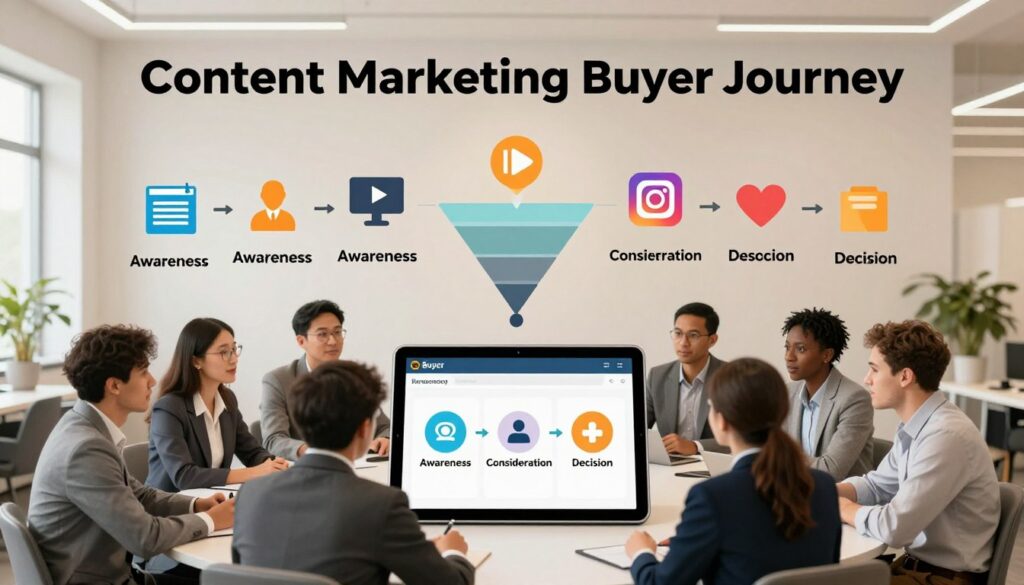
Awareness that teaches, not sells
Early-stage pieces teach and clarify. Think how-to articles, beginner guides, and short educational videos. These match search queries and help potential customers feel understood.
Consideration that connects needs to solutions
Mid-funnel assets help people compare options. Use comparison checklists, feature explainers, and case studies. Address objections with pricing pages, timelines, and “what to expect” notes.
Purchase that closes with proof
Near the decision, show proof: demos, testimonials, buyer’s guides, and clear guarantees. Strong differentiation statements reduce perceived risk and speed sales.
“Deliver the right message at each step and your work becomes a predictable lead engine.”
- Match formats to stage: short-form for discovery, long-form for evaluation, proof-heavy for closing.
Setting Goals That Tie Content to Leads and Sales
Start by defining measurable goals so every piece of work links to real business results.

Choosing objectives
Pick a primary aim for each asset. Goals keep teams focused and make ROI provable.
- Awareness — reach and impressions
- Engagement — time on page, shares, comments
- Lead generation — form fills, demo or quote requests
- Conversion — pipeline moves and influenced revenue
- Retention — repeat purchases and re-engagement
Aligning KPIs to outcomes
Translate goals into metrics the company cares about. Move beyond pageviews to leads captured and demo asks.
- Track content-assisted conversions to credit supportive assets.
- Set baselines, then make monthly targets for improvement.
- Use funnel metrics to connect creative work to sales efficiency.
Remember: traffic is a means, not the result. Your marketing strategy should use these goals to feed positioning, pipeline, and retention across the business.
Audience Research That Makes Your Content Convert
Start by learning who truly needs your offers and why they search for answers online.
Audience research prevents generic work and raises conversion. When topics match real needs, visitors become engaged prospects. Good research shifts your effort from guessing to solving specific problems.

Build buyer personas from real inputs
Use sales calls, support tickets, reviews, chat logs, and CRM notes to assemble profiles. Note goals, blockers, and typical language they use.
Capture demographics and motive-based signals so writers address real customers, not imagined ones.
Map questions to intent-based topics
Turn pain points into searchable outlines: “What is…,” “How to…,” “Cost of…,” “Best way to…,” “X vs Y,” and “Near me.”
Validate demand with keyword tools, “People also ask,” internal search, and competitor gap checks.
Find a consistent brand voice
Define tone, reading level, core vocabulary, and a short belief statement so the message stays coherent across channels.
Create a one-page voice guide and an editorial checklist so multiple writers produce steady, high-quality work.
“Research aligned to intent improves engagement and the quality of leads, not just volume.”
Building a Content Marketing Strategy You Can Sustain
Start with a simple three- to six-month rhythm that matches budgets and staff hours.
Define a sustainable strategy that fits real capacity. Match frequency to people, approval steps, and funds so the plan runs consistently for months.

Editorial planning with a realistic calendar
Build a calendar that lists frequency, topics, formats, owners, deadlines, and promotion steps for each asset.
- Keep the first plan to three to six months.
- Assign one owner per piece to speed approvals.
- Block promotion windows so publishing triggers outreach.
Balancing evergreen and timely work
Evergreen guides deliver steady search traffic. Timely posts capture spikes and public attention.
Repurpose timely pieces later into evergreen resources to extend their value and save time.
Quality control and roles
Define who supplies subject input, who writes, who edits, and who signs off for publishing.
What “good” looks like: accurate facts, clear language, useful next steps, and a final QA pass for links and claims.
Repurposing to save time
Turn one cornerstone asset into social posts, an email sequence, a short video script, and a checklist download.
Use simple tools: a shared calendar, a brief template, and a QA checklist to keep quality steady across formats.
“Consistency beats volume: a steady cadence trains readers and improves internal speed.”
Choosing Content Formats That Bring in Potential Customers
The right format answers a buyer’s immediate question and nudges them closer to a decision.

Match format to intent: use what a potential customer needs at that moment. Short posts and clips work for discovery. Long guides and reports help with deeper decisions.
Long-form vs. short-form: when each works
Long-form supports search depth and detailed comparisons. Use it for guides, white papers, and long blog posts that buyers consult while deciding.
Short-form aids distribution and quick education. Use it for social posts, newsletters, and short how-to clips.
Mapping formats to goals
- How-to posts — solve a specific problem.
- Guides — teach a full process.
- Case studies — provide proof to convert.
- Checklists — drive immediate action and downloads.
- Research reports — build authority and links.
Video content shines for demos and walkthroughs — any “show me” moment where visuals cut confusion.
“Stack formats: a guide + short summary post + downloadable checklist captures different readers and converts more leads.”
Start small: pick 2–3 primary formats, maintain quality, and focus on clear, actionable information.
Blog Posts That Generate Traffic and Leads
Each post is an opportunity to be found, trusted, and contacted.
How blogging supports SEO: more indexed pages increase the chance your website ranks for relevant search queries. Sites with active blogs show 434% more indexed pages and 97% more inbound links, which boosts discoverability and long-term traffic.
Topic frameworks that build authority
Match posts to real buyer questions. Use formats like “How to choose…,” “Cost of…,” “Common mistakes…,” “Checklist…,” and “X vs Y.”
Bundle these into a pillar + cluster model so one core guide supports several shorter posts and improves topical authority.
Write for readers and search
Answer the question quickly, then go deeper. Use clear headings, bullet lists, and short paragraphs so readers can scan and still gain value.
On-page elements that convert
- Strong headings that match intent.
- Internal links from related posts to guide visitors across your site.
- Contextual CTAs and lead magnets—templates, audits, or consultation offers tied to the post.
- Proof elements near decision points: quotes, stats, or brief case snippets.
“Businesses with blogs get about 67% more leads than those without.”
Video Content That Boosts Engagement and Purchase Confidence
Buyers decide quicker when they can see how a product works and fits their needs.
Why video helps: it demonstrates the product or service in real situations and lowers perceived risk. Branded videos influence purchase behavior—about 88% of people say a branded clip convinced them to buy. Ninety-one percent of practitioners now use video as a core tool.
Where to place videos for impact
- Social platforms for discovery and reach.
- Product pages to boost conversion and clarity.
- Buyer’s guides to support evaluation and trust.
Make every clip useful
Prioritize demos, explainers, how-to videos, onboarding clips, and FAQ objection-handlers. Use consistent scripts, simple lighting and audio, branded templates, and captions for accessibility.
Measure beyond views: track watch time, clicks to product pages, assisted conversions, and final sales. End each video with a clear call to action—request a quote, view a demo, or download a comparison guide.
Social Media Content That Distributes and Amplifies Your Message
When you place useful assets on the right platforms, they start conversations that lead to qualified inquiries.
Role in a system: social media distributes and amplifies site assets so your pages reach new audience pockets quickly. Use posts to point people to guides, videos, and checklists that live on your site.
Pick 1–3 high-potential platforms
Choose platforms where your audience already spends time. Match industry norms and your team’s production ability. Focus on consistency over ubiquity.
Adapt creative without diluting brand
Keep the core message and voice stable. Change length, visuals, and format to fit each platform’s expectations while protecting your brand identity.
Drive real engagement, not empty clicks
Use prompts that invite stories, Q&A threads, short teaching clips, and saveable checklists. Set clear expectations in each post and match the landing page to the promise.
- Repurpose one article into 3–5 social media posts per week.
- Track replies, profile visits, signups, and assisted leads—not only link clicks.
- Prioritize topics that spark meaningful replies and qualified conversations.
“Measure by the quality of conversations you earn, not by vanity metrics alone.”
Email Marketing That Nurtures Leads Into Customers
Email remains the one channel where you own the inbox and control the message. Use it to deepen relationships and move readers from your blog to a purchase decision.
Why email is a direct relationship channel
Email is owned media: unlike feeds and algorithms, messages land in a subscriber’s inbox. That direct line strengthens relationships over time and drives repeat visits to your website.
Segmentation and personalization that improve results
Split lists by industry, lifecycle stage, and user behavior (clicked pricing, downloaded a guide). Send problem-focused notes, not just name tokens.
- Industry or role
- Stage: awareness, consideration, purchase
- Behavior: downloads, clicks, video watches
Newsletter ideas and nurture sequences
Mix short how-to tips, new blog highlights, customer stories, video recaps, and curated insights. Build a welcome series, a problem/solution drip, objection-handling emails, and a “ready to talk?” conversion prompt.
How to measure impact
Track open rate, click-through rate, conversion rate, replies, and booked sales meetings. Note that email often yields high ROI—reports cite about $36 returned per $1 spent—so measure both immediate conversions and assisted leads.
SEO and Content Marketing: Getting Found in Search
Good search visibility starts with answering real questions people type into the search bar.
How the two work together: readable pages create crawlable assets and search tactics ensure those pages match user intent. Build pages that solve a single problem, then use SEO to surface them when prospects look for answers.
Keyword research in plain language means collecting the words customers actually use: problems, costs, comparisons, and local phrases. Prioritize 1–2 primary phrases per page and related variants that match real questions.
Use phrases naturally: place the main phrase in the title and at least one heading, then weave variants into body text where they fit the flow. Write for clarity over density and avoid stuffing.
Practical E-E-A-T steps
Show real experience with examples, cite credible sources, and list author credentials for trust. Keep claims accurate and update stats or case details regularly.
- Focus each page on one intent and link to supporting pages for related questions.
- Refresh outdated information and tighten internal links to protect rankings.
- Measure by intent: which queries bring qualified visitors and which pages convert to leads.
“Make pages that answer the question you promised — search rewards usefulness.”
Distribution and Promotion Beyond Your Website
Publishing is step one; deliberate distribution makes a post do work for your business.
Why distribution is not optional: even excellent content marketing fails if it never reaches the right people repeatedly. Promotion turns assets into leads, not just pageviews.
Owned, earned, and partner channels
Owned — website, email list, and company newsletters you control.
Earned — shares, PR mentions, and backlinks that boost reach and trust.
Partner placements — guest posts, co-marketing, and third-party features that tap new audiences.
Repeatable promotion workflow
- Announcement post on site and social posts.
- Email send to segmented lists and internal sales share.
- Internal linking updates and resource pages.
- Outreach to partners and PR contacts for placements.
- Track with simple tools and assign follow-up times.
Refine channels with analytics
Reshare evergreen guides quarterly, repackage small posts for platforms, and update visuals over time.
Use analytics to double down on channels that deliver qualified leads and cut noise. Equip sales and success teams to share assets one-to-one so promotion includes direct outreach, not only public media.
Measuring Results: Metrics That Prove ROI
A clear measurement plan turns disparate stats into proof that your work drives revenue.
Start by linking metrics to goals: awareness, leads, sales, and retention. A documented plan shows which signals mean progress and which need adjustment.
Awareness and visibility
Track visitors, time on page, click-throughs to other pages, and channel trendlines. Watch traffic by source so you know which efforts move the needle.
Brand health
Measure share of voice against competitors, sentiment from reviews and comments, and mentions or shares that show brand influence. These speak to long-term trust and reach.
Lead and sales tracking
Map the funnel: content → lead capture → sales call → closed deal. Include assisted conversions and steps like pricing views, demo requests, and checkout starts to show how pieces drive sales.
Innovation and feedback loops
Use questions, objections, and recurring comments to refine both the product and service. Returning visitors and subscribers are proof of growing trust and better future conversion odds.
“Measure the signals that map to business outcomes, not just raw traffic.”
Common Content Marketing Challenges and How to Overcome Them
Even experienced teams hit walls: noisy markets, scarce hours, and slow returns can stall good work.
Stand out by getting specific. In crowded niches, target narrow problems, share real examples, and publish honest tradeoffs — even “who this is not for.” That clarity beats broad, generic posts and helps your company attract the right customers.
Build a repeatable ideation engine. Mine support tickets, sales objections, and competitor gaps for high-intent topics. Turn those prompts into an editorial backlog so ideas arrive from real questions, not bursts of inspiration.
Protect cadence with batching and templates. Create article outlines, short-form versions, and repurposeable assets so limited time still yields steady output. One afternoon of batching can fuel weeks of distribution.
Quality and scale without friction
Set standards that scale: briefs, an editing checklist, and a single source of truth for claims and positioning. Use small QA passes rather than endless rewrites to keep quality high and time low.
Staff wisely. Combine in-house experts, vetted freelance writers, and a single editor to preserve expertise and speed approvals. This hybrid setup helps marketers keep messages accurate and clear.
Measuring ROI when impact compounds
Explain the lag: results compound over months. Use leading indicators — qualified traffic, engagement depth, and lead quality — to prove progress before revenue fully appears.
“Improve steadily: update older posts, tighten CTAs, and refine distribution before chasing new topics.”
- Target narrow problems, not broad headlines.
- Systematize idea discovery from real customer signals.
- Batch work and repurpose to save time and keep rhythm.
- Use simple standards and a clear editorial owner for quality.
Does Content Marketing Still Work in 2026?
Short answer: yes — but only when it is planned, relevant, and maintained.
In 2026, a smart plan and steady quality still win attention—volume alone does not.
Why strategy, quality, and personalization matter more than volume
Proven condition: content marketing works when you follow a documented content marketing strategy and keep standards high.
Segment by audience and stage. Use email, social media, and on-site suggestions to serve timely, useful recommendations.
Adapting to changing algorithms and platform shifts without losing momentum
Diversify where you publish so one algorithm change can’t stop growth. Strengthen owned channels — your site and list — to control outcomes.
Build resilience by repurposing winners across platforms and tracking which channels deliver qualified inquiries.
Mobile-first and accessibility considerations that protect performance
Speed, scannable headings, and simple lead forms cut friction on phones. Add captions, transcripts, and descriptive alt text to boost usability and reach.
“Show real experience, cite sources, and refresh material regularly to keep trust and rankings.”
- Document a clear plan and publish on a steady cadence.
- Personalize by segment and lifecycle stage.
- Optimize for mobile and accessibility to protect long-term performance.
Conclusion
Close the loop by turning helpful information into repeatable systems that drive leads and sales.
Core takeaway: content marketing brings clients when you use content deliberately across the buyer journey with clear goals, research, and steady execution.
Pick a sustainable plan, publish high-value assets, and distribute them across owned channels and partner media. Blogs can drive measurable leads and video improves purchase confidence when used correctly.
Start with one cornerstone piece and repurpose it: blog + email + social + short video to build momentum.
Immediate steps: define your audience, choose 2–3 formats, create a 90-day calendar, and track leads and sales influenced—not only traffic. This ties every asset back to the customer experience and lowers buying risk for your product service.