

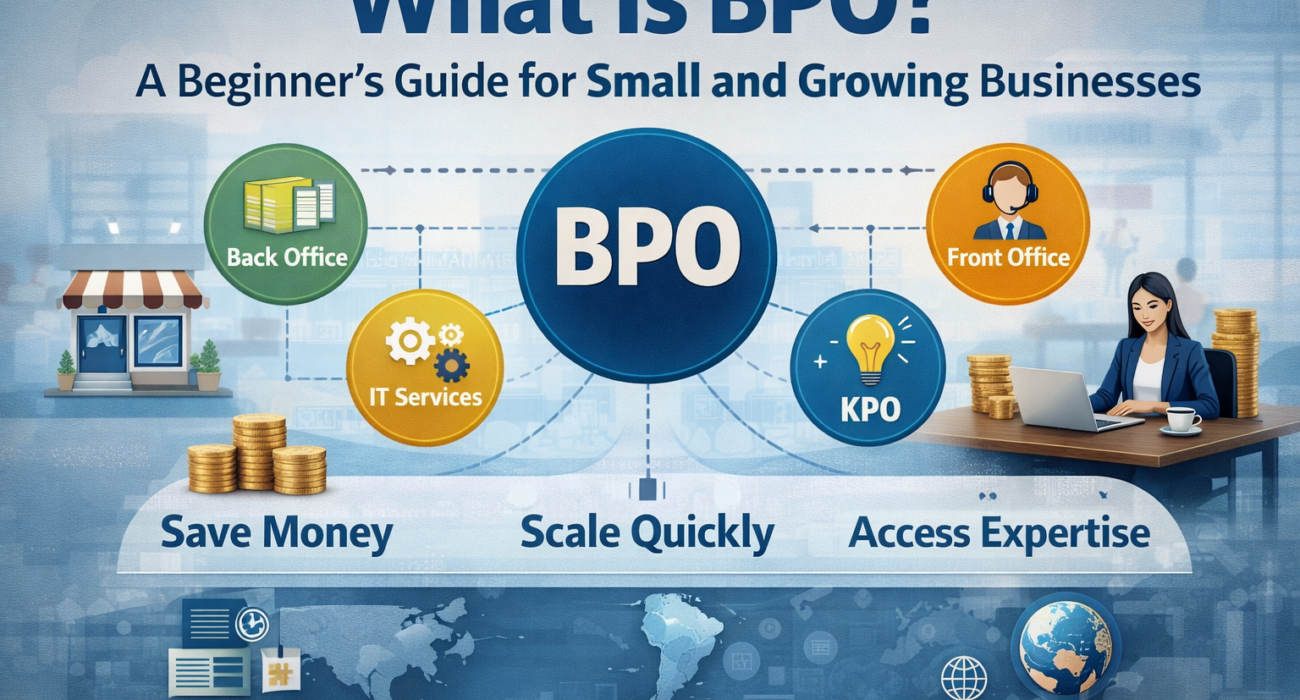
What Is BPO? A Beginner’s Guide for Small and Growing Businesses
Introduction to Business Process Outsourcing (BPO)
If you’re running a small or growing business, you’ve probably felt stretched thin. Managing customers, handling finances, supporting IT systems, and running daily operations can quickly overwhelm internal teams. This is where the question arises: What Is BPO? A Beginner’s Guide for Small and Growing Businesses aims to answer exactly that.
Business Process Outsourcing, commonly known as BPO, allows companies to delegate non-core tasks to external specialists. Instead of hiring full-time staff for every function, businesses can outsource specific processes to experts who handle them more efficiently and at a lower cost. For startups and growing companies, BPO is no longer a luxury—it’s a strategic growth tool.
What Is BPO? Meaning and Definition
Business Process Outsourcing (BPO) is the practice of contracting specific business functions or processes to a third-party service provider. These processes can include customer support, accounting, human resources, IT services, marketing, and more.
In simple terms, BPO allows businesses to focus on what they do best while external experts manage time-consuming or specialized tasks. This model helps improve efficiency, reduce costs, and scale operations faster.
BPO is widely used across industries such as healthcare, finance, e-commerce, technology, and real estate, making it a flexible solution for businesses of all sizes.
How Business Process Outsourcing Works
The BPO process usually follows these steps:
-
Identify tasks to outsource – Non-core or repetitive tasks are the most common candidates.
-
Select a BPO provider – Businesses evaluate vendors based on expertise, cost, and reliability.
-
Define scope and KPIs – Clear service-level agreements (SLAs) are established.
-
Transition and onboarding – Processes, tools, and data are shared securely.
-
Ongoing management and optimization – Performance is monitored regularly.
Once implemented correctly, BPO becomes an extension of your business rather than an external service.
Types of BPO Services
BPO services are typically categorized based on the nature of work they handle.
Back-Office BPO Services
Back-office BPO focuses on internal business operations that customers don’t directly see, such as:
-
Accounting and bookkeeping
-
Payroll processing
-
Data entry and data management
-
Human resources administration
-
Procurement and inventory management
These services help streamline internal workflows and reduce administrative burdens.
Front-Office BPO Services
Front-office BPO deals with customer-facing processes, including:
-
Customer support and call centers
-
Sales and lead generation
-
Technical support
-
Appointment scheduling
Front-office outsourcing is especially valuable for businesses aiming to deliver 24/7 customer service.
Knowledge Process Outsourcing (KPO)
KPO involves outsourcing high-skill, knowledge-based tasks such as:
-
Market research
-
Business analytics
-
Legal services
-
Financial analysis
These services require specialized expertise and are often used by growing companies seeking strategic insights.
IT-Enabled Services (ITES)
ITES focuses on technology-driven processes like:
-
Software development
-
IT support and maintenance
-
Cloud services
-
Cybersecurity monitoring
ITES helps businesses stay technologically competitive without heavy internal investments.
Onshore vs Nearshore vs Offshore BPO
BPO services can also be classified based on location.
-
Onshore BPO: Services are outsourced within the same country.
-
Nearshore BPO: Services are outsourced to neighboring or nearby countries.
-
Offshore BPO: Services are outsourced to distant countries, often for cost savings.
Each option has its pros and cons, depending on budget, time zone compatibility, and communication needs.
Common BPO Services Used by Small Businesses
Small and growing businesses commonly outsource:
-
Customer support and call center services
-
Virtual assistants and administrative support
-
Accounting and bookkeeping
-
Digital marketing and SEO
-
IT support and helpdesk services
These functions allow small teams to operate like much larger organizations.
Why Small and Growing Businesses Use BPO
Small businesses face unique challenges, including limited budgets, small teams, and rapid growth demands. BPO helps overcome these obstacles by providing access to skilled professionals without long-term commitments.
Outsourcing also allows founders and managers to focus on strategy, innovation, and customer relationships rather than day-to-day operational tasks.
Benefits of BPO for Small and Growing Businesses
Some of the biggest advantages include:
-
Cost savings: Lower labor and infrastructure costs
-
Scalability: Easily scale services up or down
-
Access to expertise: Skilled professionals and advanced tools
-
Improved efficiency: Faster turnaround times
-
Focus on core business: More time for growth initiatives
According to industry reports, businesses using BPO can reduce operational costs by up to 30–50% .
Potential Risks and Challenges of BPO
While BPO offers many benefits, it also comes with challenges:
-
Data security and privacy concerns
-
Communication barriers
-
Quality control issues
-
Dependency on third-party vendors
These risks can be minimized by choosing reputable providers and setting clear expectations.
BPO Costs Explained for Beginners
BPO pricing depends on factors such as service type, location, and complexity.
-
Offshore BPO: $8–$15 per hour
-
Nearshore BPO: $15–$25 per hour
-
Onshore BPO: $30–$50 per hour
Many providers also offer per-project or per-agent pricing, making BPO flexible for different budgets.
How to Choose the Right BPO Provider
When selecting a BPO partner, consider:
-
Industry experience
-
Data security standards
-
Scalability options
-
Transparent pricing
-
Client reviews and case studies
A strong BPO partnership should feel collaborative, not transactional.
Real-World Examples of BPO
-
A startup outsources customer support to provide 24/7 service
-
An e-commerce store uses BPO for order processing
-
A SaaS company outsources technical support and QA testing
These examples show how BPO adapts to different business needs.
FAQs About BPO
1. Is BPO only for large companies?
No, small and growing businesses benefit greatly from BPO.
2. Is BPO expensive?
BPO is often more affordable than hiring in-house staff.
3. Can I outsource multiple processes?
Yes, many providers offer bundled services.
4. Is offshore BPO safe?
It can be, if the provider follows strong security standards.
5. How long does it take to start BPO?
Most projects begin within 2–4 weeks.
6. Can BPO scale as my business grows?
Yes, scalability is one of BPO’s biggest strengths.
Conclusion: Is BPO Right for Your Business?
Understanding What Is BPO? A Beginner’s Guide for Small and Growing Businesses helps entrepreneurs make smarter operational decisions. BPO is not just about cutting costs—it’s about building a flexible, efficient, and scalable business model.
For small and growing businesses, outsourcing the right processes can unlock growth, improve service quality, and create a competitive edge in today’s fast-moving market.