


This guide will help you navigate the key considerations, benefits, and challenges of both local and global call center options, providing a framework to make the best decision for your specific business needs and customer expectations.
Understanding Local vs Global Call Center Models
Before diving into the comparison, it’s essential to understand what each model entails and how they fundamentally differ in their approach to customer service delivery.
Local (Onshore) Call Centers
Local or onshore call centers operate within the same country as your primary customer base. These centers employ agents who share the same cultural background, language proficiency, and geographical proximity as your customers. Companies choose this model when cultural alignment and communication quality are top priorities.
Local call centers typically feature:
- Native language speakers with natural cultural understanding
- Synchronized time zones with your customer base
- Familiarity with local customs, slang, and references
- Higher labor costs but potentially higher quality interactions
- Easier management and oversight due to proximity
Global (Offshore) Call Centers
Global or offshore call centers operate in countries different from your primary customer base. Popular locations include India, the Philippines, Mexico, and Eastern European countries. Companies typically choose this model to reduce operational costs while maintaining 24/7 service availability.
Global call centers commonly offer:
- Significantly lower operational and labor costs
- Access to large talent pools in countries specializing in BPO services
- Round-the-clock coverage through different time zones
- Multilingual capabilities for international customer bases
- Scalability during peak periods without major infrastructure investments
Cost Structure Comparison
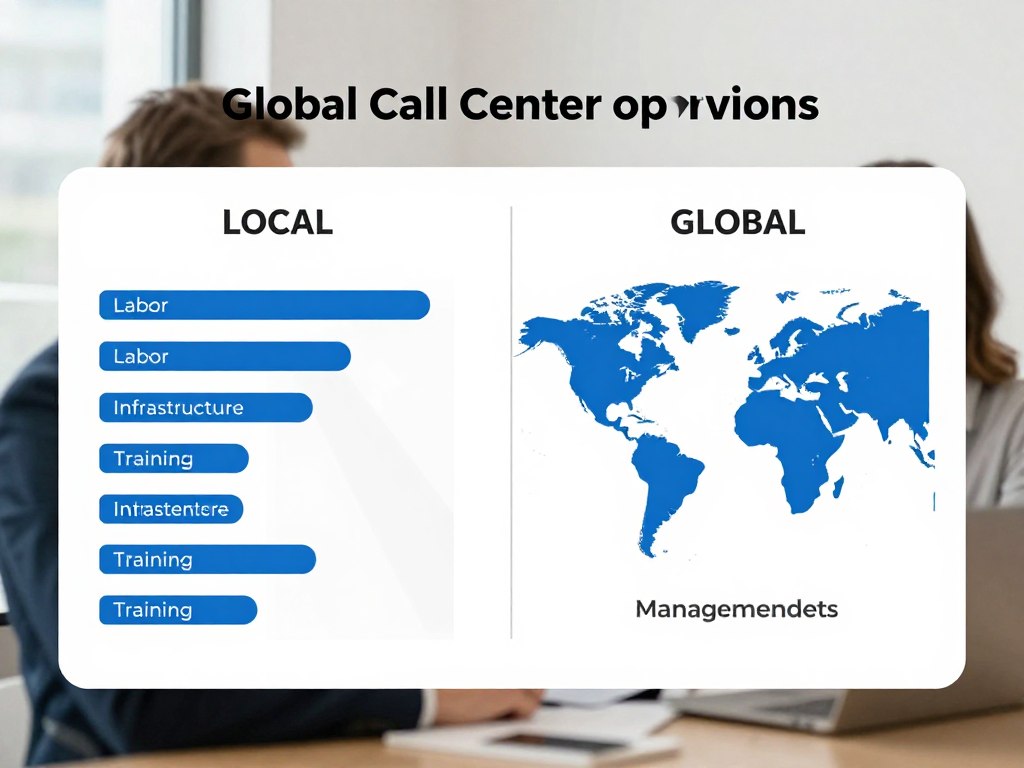
Cost considerations often drive the initial interest in exploring global call center options. However, a comprehensive cost analysis reveals nuances beyond simple hourly rates.
| Cost Factor | Local Call Centers | Global Call Centers |
| Labor Costs | Higher ($25-$65/hour) | Lower ($8-$18/hour) |
| Infrastructure | Higher initial investment | Often included in service package |
| Training | Lower (faster cultural onboarding) | Higher (cultural/accent training required) |
| Management Overhead | Lower (easier oversight) | Higher (remote management challenges) |
| Quality Assurance | Lower (fewer communication issues) | Higher (more monitoring needed) |
| Customer Retention Impact | Positive (potentially higher satisfaction) | Variable (depends on implementation) |
While global call centers offer clear savings on hourly labor rates, it’s important to consider the total cost of ownership. Hidden costs like additional training, quality monitoring, and potential customer retention issues can offset some of the apparent savings of offshore operations.
According to industry research, businesses can reduce operational costs by 20-30% through global outsourcing, but this varies significantly by industry, service complexity, and quality requirements.
Quality and Communication Considerations

Language Proficiency and Accent Considerations
Communication clarity stands as one of the most significant factors in customer service satisfaction. Local call centers naturally excel in this area, with agents who speak the same language and dialect as your customers. Global centers can present challenges with accents and language nuances, though many offshore locations now offer accent neutralization training and employ agents with excellent language skills.
Cultural Understanding
Cultural alignment extends beyond language to include understanding of local customs, holidays, regional references, and communication styles. Local agents intuitively grasp these nuances, while global teams may require extensive training to bridge cultural gaps.
Local Call Center Advantages
- Natural understanding of cultural references
- Intuitive grasp of customer expectations
- Familiarity with local regulations and practices
- Reduced miscommunication risk
- Higher customer comfort level
Global Call Center Challenges
- Potential accent and language barriers
- Cultural misunderstandings may occur
- Different communication styles and expectations
- Need for extensive cultural training
- Possible customer bias against offshore support
Many successful global call centers overcome these challenges through rigorous training programs, cultural immersion, and quality monitoring. The key is determining whether your specific service needs and customer expectations can accommodate the learning curve that may come with global operations.
Need help evaluating your call center communication quality?
Our team can assess your current operations and recommend improvements for either local or global models.
Customer Perception and Brand Image

How customers perceive your support services directly impacts your brand reputation. The choice between local and global call centers can significantly influence this perception.
Trust and Brand Alignment
Studies show that customers often associate local support with higher quality and greater brand investment. Some customers may perceive offshore support as a cost-cutting measure rather than a service enhancement. This perception varies by industry and customer demographic.
Industries with sensitive information or complex products often benefit more from local support, as customers may feel greater trust when speaking with agents in their own country. Meanwhile, technical support for digital products may face fewer perception challenges when delivered globally.
Marketing Your Call Center Location
Some companies actively promote their local call center operations as a competitive advantage, using “locally staffed” or “US-based support” as selling points. Others highlight the global nature of their operations to emphasize 24/7 availability and international capabilities.
“Nearly 80% of customers report that the quality of customer service is as important as the quality of products and services a company offers.”
Your decision should align with your overall brand positioning and customer expectations. Premium brands may find that local support reinforces their quality promise, while value-oriented brands might benefit from the cost efficiencies of global operations without significant brand impact.
Operational Flexibility and Scalability

Time Zone Coverage
Global call centers offer a natural advantage in providing 24/7 coverage across different time zones without requiring night shifts. This can be particularly valuable for businesses with international customers or those requiring round-the-clock support.
Local call centers can achieve similar coverage, but typically at higher costs due to shift differentials and overnight staffing challenges. Some businesses adopt a hybrid approach, using local teams during business hours and global teams for after-hours support.
Scaling Capacity
Both models offer scaling capabilities, but in different ways:
Local Scaling
- More control over hiring processes
- Direct oversight of quality during expansion
- Potentially slower ramp-up time
- Higher costs for rapid expansion
- Limited by local talent pool availability
Global Scaling
- Access to large talent pools
- Often faster ramp-up capabilities
- Lower costs for rapid expansion
- Established processes for scaling
- Potential quality variability during growth
Management Complexity
Managing global operations introduces additional complexity in oversight, quality control, and team cohesion. Time zone differences can complicate real-time management and training, while cultural differences may require adapted leadership approaches.
Local operations typically offer more straightforward management with direct oversight and fewer communication barriers, but may lack the flexibility and cost advantages of global teams during periods of rapid growth or contraction.
Hybrid Approach: Many businesses find success with a hybrid model, using local teams for complex or sensitive interactions and global teams for routine matters or after-hours support. This balances quality with cost-efficiency and operational flexibility.
Data Security and Regulatory Compliance

Security and compliance considerations can significantly impact your call center location decision, particularly for businesses in regulated industries or those handling sensitive customer data.
Data Protection Regulations
Different countries maintain varying levels of data protection regulations. Local call centers operate under the same regulatory framework as your business, simplifying compliance. Global operations may introduce additional complexity with cross-border data transfers and varying local regulations.
Key regulations that may impact your decision include:
- GDPR (European Union)
- HIPAA (US healthcare)
- PCI DSS (payment card industry)
- CCPA/CPRA (California)
- Industry-specific regulations
Security Infrastructure
Both local and global call centers can implement robust security measures, but oversight and verification may be more challenging with offshore operations. When evaluating global providers, carefully assess their security certifications, infrastructure, and compliance history.
For businesses in highly regulated industries like healthcare, financial services, or those handling sensitive personal data, the compliance advantages of local call centers may outweigh the cost benefits of global operations.
Modern cloud-based call center technologies can help address some security concerns by keeping sensitive data on secure servers rather than local workstations, regardless of agent location. However, physical security and personnel practices remain important considerations that vary by location.
Decision Framework: Which Should You Offer?
Choosing between local and global call center services requires a strategic approach based on your specific business needs, customer expectations, and operational goals. Consider the following framework to guide your decision:
Key Questions to Ask
What is your primary business objective?
If cost reduction is your primary goal, global options may be more attractive. If quality and brand perception are paramount, local services might be the better choice. Balance these priorities based on your specific situation.
Who are your target customers and what are their expectations?
Consider your customer demographics, preferences, and service expectations. Some customer segments are more sensitive to accent differences or expect local support, while others prioritize availability and resolution speed regardless of location.
What is the nature of your product or service?
Complex products or services with nuanced support needs may benefit from local expertise. Straightforward support functions might be effectively delivered through global teams with proper training.
What are your growth plans and scalability needs?
If rapid scaling is anticipated, global operations may offer advantages in flexibility and cost-efficiency. Stable operations might benefit from the consistency and quality control of local teams.
What is your budget and risk tolerance?
Assess your financial constraints and willingness to accept potential quality variability or management challenges in exchange for cost savings.
Industry-Specific Considerations
Different industries have unique requirements that may influence your decision:
| Industry | Local Advantage | Global Advantage | Recommended Approach |
| Healthcare | Compliance, privacy, medical terminology | 24/7 availability, cost | Primarily local with limited global for non-sensitive functions |
| Financial Services | Security, regulatory knowledge, trust | Extended hours, scalability | Hybrid with local for complex/sensitive matters |
| E-commerce | Cultural understanding, upselling | 24/7 support, seasonal scaling | Global with strong training or hybrid model |
| Technology | Complex troubleshooting | Technical talent pools, continuous coverage | Tiered approach with global first-level support |
| Luxury Brands | Premium experience, brand alignment | International coverage | Primarily local to maintain brand positioning |
Hybrid and Alternative Models

Beyond the binary choice between purely local or global operations, several alternative models offer the benefits of both approaches while mitigating their respective challenges.
Nearshore Call Centers
Nearshore call centers operate in countries that are geographically closer to your primary market, often in similar or adjacent time zones. For US companies, this typically means locations in Canada, Mexico, or the Caribbean. Nearshore options offer a middle ground with:
- Moderate cost savings compared to domestic operations
- Reduced cultural and time zone differences
- Often stronger English language skills and cultural alignment
- Easier travel for training and oversight
- Potential trade and regulatory advantages through agreements like USMCA
Tiered Support Models
Many businesses implement a tiered approach where different types of customer interactions are handled by different teams based on complexity and sensitivity:
Tier 1: Global Teams
Handle routine inquiries, basic troubleshooting, and initial customer contact. These interactions benefit from cost efficiency and 24/7 availability.
Tier 2: Specialized Teams
Address more complex issues requiring deeper product knowledge or technical expertise. May be global or local depending on talent availability.
Tier 3: Local Experts
Manage sensitive situations, high-value customers, or complex problem resolution requiring cultural nuance and advanced expertise.
Follow-the-Sun Model
This approach utilizes call centers in different time zones to provide continuous coverage without requiring overnight shifts. Work is transferred between locations as business hours end in one region and begin in another, ensuring that agents are always working during their daytime hours.
This model can be particularly effective for businesses with global customers or those requiring 24/7 technical support, combining the quality benefits of daytime operations with continuous availability.
Explore hybrid call center solutions tailored to your business
Our experts can help you design a customized approach that balances quality, cost, and operational flexibility.
Keys to Successful Implementation

Regardless of which model you choose, certain best practices can significantly improve your chances of success:
For Local Call Centers
- Invest in comprehensive training programs that build product knowledge and soft skills
- Implement robust quality monitoring and coaching processes
- Leverage technology to improve efficiency and reduce costs
- Create career paths to reduce turnover and build institutional knowledge
- Consider flexible staffing models to manage volume fluctuations
For Global Call Centers
- Develop thorough cultural training programs to bridge understanding gaps
- Invest in accent neutralization and language skills development
- Create detailed knowledge bases and decision trees to guide interactions
- Implement robust security protocols and compliance training
- Establish clear communication channels between headquarters and offshore teams
Technology Considerations
Modern call center technology can help bridge the gap between local and global operations through:
- Cloud-based platforms that ensure consistent tools across locations
- AI-powered routing to match customers with the most appropriate agents
- Quality monitoring tools that identify training opportunities
- Knowledge management systems that provide agents with accurate information
- Self-service options that reduce call volume for routine matters
“The success of any call center model depends less on its location and more on the quality of implementation, training, and ongoing management.”
Conclusion: Making the Right Choice for Your Business

The choice between local and global call center services is not one-size-fits-all. The right decision depends on your specific business objectives, customer expectations, budget constraints, and operational requirements.
Local call centers offer advantages in communication quality, cultural alignment, and brand perception, but at higher operational costs. Global operations provide cost savings and scalability benefits but may present challenges in communication and oversight.
Many successful businesses are finding that hybrid models offer the best of both worlds, allowing them to optimize for both quality and cost-efficiency by strategically allocating different types of customer interactions to the most appropriate service model.
As you evaluate your options, focus on your customers’ needs and expectations first, then consider how different call center models can meet those needs while aligning with your business objectives and constraints. With careful planning and implementation, either approach can deliver excellent customer experiences that strengthen your brand and support your business growth.
Need expert guidance on your call center strategy?
Our team specializes in helping businesses design and implement optimal call center solutions that balance quality, cost, and operational flexibility.
Request Your Call Center Strategy Assessment

Complete the form below to receive a personalized assessment of which call center model would best suit your business needs. Our experts will analyze your requirements and provide customized recommendations.