


Did you know that companies using modern contact center software report a 35% faster resolution of customer issues? This stark improvement highlights a critical crossroads for business leaders.
Choosing between a cloud-based and an on-premise system is a strategic decision. It impacts your budget, team efficiency, and the entire customer experience.
This guide provides a clear, objective analysis. We break down the total cost of ownership, from upfront CapEx to ongoing OpEx. You will see the long-term value and return on investment for each model.
We cover essential benefits like scalability and omnichannel support. The article also explores current market trends, including AI integration.
Our goal is to equip you with actionable insights. You will learn how to calculate tangible ROI and improve agent performance. This is your essential resource for making an informed choice about your contact center infrastructure.
Introduction: The Defining Choice for Modern Customer Service
In an era where customer expectations evolve rapidly, your contact infrastructure becomes a strategic asset or a competitive liability. The technology supporting your team shapes every interaction. It determines whether you deliver seamless experiences or frustrating delays.
Legacy systems create constant operational challenges. These include long wait times, high agent turnover, and disconnected tools. Frustrated customers often get stuck in slow resolution loops. Outdated software only makes these problems worse.

Traditional on-premise setups contribute to persistent pain points. They often feature inefficient call routing that burns out staff. This leads to poor customer satisfaction scores. These systems struggle to adapt quickly to changing business needs.
The right solutions can transform this dynamic. Modern tools address core challenges through internet-based architecture. They incorporate AI-powered automation and real-time agent support. This helps teams operate more smoothly while making customers happier.
Data shows these tools streamline critical tasks. They improve handling of inbound calls and intelligent routing. This enhances overall contact center performance. The result is better service experiences for everyone involved.
This decision impacts far more than just technology budgets. It influences total cost of ownership, business agility, and scalability. Ultimately, it affects customer retention and revenue growth. The choice defines your operational capability and competitive advantage.
This article provides a detailed, comparative analysis. We help you navigate this complex decision with confidence. Our approach is objective and data-driven. We focus on business outcomes rather than vendor hype.
Modern platforms operate without physical hardware on-site. They rely on secure internet connections and external data centers. This differs fundamentally from traditional on-premise solutions. The architectural shift enables new levels of flexibility.
The right choice leads to improved service quality and reduced operational costs. It enables seamless scaling during peak periods. This supports sustainable business growth and stronger customer relationships.
We will break down both models objectively. Our analysis acknowledges scenarios where on-premise solutions might still offer advantages. We examine costs, features, and long-term value propositions. This prepares you to make an informed strategic choice.
What Are Cloud-Based Call Center Platforms?
The digital transformation of customer service has given rise to internet-powered solutions that eliminate physical infrastructure. These tools represent a fundamental shift in how businesses manage communications. They operate through secure web connections rather than local hardware installations.

This approach delivers comprehensive management of customer interactions. Teams can handle everything from a single interface. The model removes traditional barriers to efficiency and growth.
Definition and Core Architecture
These solutions are software-as-a-service (SaaS) offerings. They reside in remote data centers maintained by the service provider. Businesses access all functions through an internet connection.
The core architecture relies on virtualization and distributed computing. This creates a resilient foundation for operations. Multiple clients share secure, partitioned spaces within the same infrastructure.
This multi-tenant design enables cost-effective scaling. Providers manage servers, security updates, and performance optimization. Companies benefit from enterprise-grade reliability without the overhead.
Technical components work together seamlessly. Voice over Internet Protocol (VoIP) transmits conversations as data packets. Automatic call distribution (ACD) routes incoming contacts intelligently.
Interactive voice response (IVR) systems handle initial customer inquiries. API integrations connect directly with CRM and business tools. This creates a unified view of each customer’s history and needs.
How Cloud Call Center Software Operates
Agents typically use a desktop application that consolidates all communication channels. The interface combines voice functionality with messaging and email. Real-time analytics appear alongside customer information.
Managers monitor team performance through comprehensive dashboards. They track metrics like average handle time and customer satisfaction. Workforce management tools help optimize scheduling and resource allocation.
These tools support the complete operating lifecycle of a contact center. They assist with hiring and training new staff members. Intelligent routing ensures each inquiry reaches the most qualified agent.
Automation handles repetitive tasks, freeing agents for complex issues. Real-time guidance helps representatives during challenging conversations. Quality management features identify coaching opportunities.
Deployment happens remarkably quickly compared to traditional systems. Implementation often takes days or weeks rather than months. Minimal IT resources are required for setup and ongoing maintenance.
Scalability adapts to business needs instantly. Companies can add or remove agent seats with a few clicks. Features and communication channels expand based on seasonal demand.
The subscription model provides predictable operational expenses. Providers handle all infrastructure management and upgrades. Businesses focus entirely on customer experience rather than technology maintenance.
This operational model naturally supports distributed teams. Remote workers access the same tools as office-based colleagues. Geographic flexibility becomes a strategic advantage for talent acquisition and retention.
Understanding Traditional On-Premise Call Center Systems
Before the rise of internet-based solutions, businesses relied entirely on physical hardware installed within their own facilities to manage customer communications. This established model represents a fundamentally different approach from modern subscription services. Companies own and operate all the technology themselves.
The traditional setup requires dedicated space for equipment. This often includes server rooms with climate control and secure access. Telecommunications hardware connects directly to public phone networks.
Internal IT teams bear full responsibility for this infrastructure. They handle everything from initial setup to ongoing maintenance. This creates both control challenges and operational burdens.

Legacy Infrastructure and Management
Traditional systems consist of proprietary servers, switches, and routers. These components must be purchased outright from vendors. Physical phone lines connect the business to the telephone network.
Private branch exchange (PBX) equipment forms the core of voice capabilities. It manages internal extensions and external lines. Automatic call distributors (ACD) route incoming contacts to available staff.
Computer-telephony integration (CTI) links phone systems with business software. This allows screen pops with customer data. However, these integrations often require custom development work.
The management burden falls entirely on the company’s IT department. Teams must perform hardware maintenance and software updates. They also handle security patches and backup systems.
Disaster recovery planning becomes a complex internal project. Companies need redundant systems and failover procedures. This requires significant expertise and ongoing testing.
Businesses follow a capital expenditure (CapEx) model with these solutions. Large upfront investments cover equipment and licenses. Ongoing costs include maintenance contracts and support fees.
Customization potential represents a key advantage for some organizations. Systems can be deeply tailored to specific workflows. They integrate with legacy enterprise applications that lack modern APIs.
Perceived security advantages appeal to regulated industries. Data remains entirely within the company’s firewall. This satisfies strict compliance requirements in finance and healthcare.
| Component | Function | Management Responsibility |
|---|---|---|
| PBX System | Handles voice calls, extensions, and routing | Internal IT team |
| ACD Hardware | Distributes incoming contacts to agents | Internal IT team |
| CTI Server | Integrates telephony with business software | Internal IT team |
| Telephony Lines | Physical connections to phone network | Telecom provider & internal IT |
| Local Servers | Hosts contact center software and databases | Internal IT team |
Scalability limitations present significant challenges. Adding capacity requires purchasing and installing additional hardware. This process can take weeks or months compared to instant scaling elsewhere.
Expansion involves costly procurement cycles and physical installation. Each new agent needs dedicated equipment and connections. Seasonal fluctuations become difficult to manage efficiently.
The typical lifecycle spans 5-10 year depreciation schedules. Technology becomes obsolete during this period. Companies face costly upgrades or complete system replacements.
This model creates a control trade-off. Businesses maintain complete internal command over their systems. However, they also bear the full burden of management and lack automatic innovation updates.
Vendor dependence still exists for specialized components. Proprietary equipment requires manufacturer support. This can lead to lock-in with specific technology providers.
Traditional systems often operate separate tools for different channels. Voice, email, and chat might use disconnected software. This fragmentation hinders omnichannel customer service.
Despite these challenges, the model persists in certain environments. Organizations with unique compliance needs or existing investments may continue. The decision requires careful evaluation of total costs and capabilities.
Cloud vs. On-Premise: A Side-by-Side Comparison Matrix
A detailed comparison reveals fundamental distinctions in how businesses manage their communication systems. Each model operates with different financial, technical, and operational frameworks.
Understanding these differences helps leaders make informed choices. The right selection impacts daily workflows and long-term strategic flexibility.
| Decision Factor | Internet-Based Solutions | Traditional On-Premise Systems |
|---|---|---|
| Deployment Model | Software-as-a-Service (SaaS) accessed via web | Physical hardware installed on company premises |
| Cost Structure | Operational expenditure (OpEx) – monthly subscriptions | Capital expenditure (CapEx) – large upfront investment |
| Scalability | Elastic, on-demand scaling with few clicks | Fixed capacity requiring hardware purchases |
| Implementation Time | Days or weeks for full deployment | Months for procurement, installation, configuration |
| Maintenance Responsibility | Provider handles updates, patches, infrastructure | Internal IT team manages everything |
| Feature Updates | Continuous, automatic updates with new capabilities | Costly upgrade projects every few years |
| Security Model | Provider-managed with enterprise certifications | Complete internal control and data localization |
| Disaster Recovery | Built-in redundancy across geographic regions | Requires duplicate infrastructure investments |
| Integration Approach | API-first architecture with pre-built connectors | Often requires complex, custom integration projects |
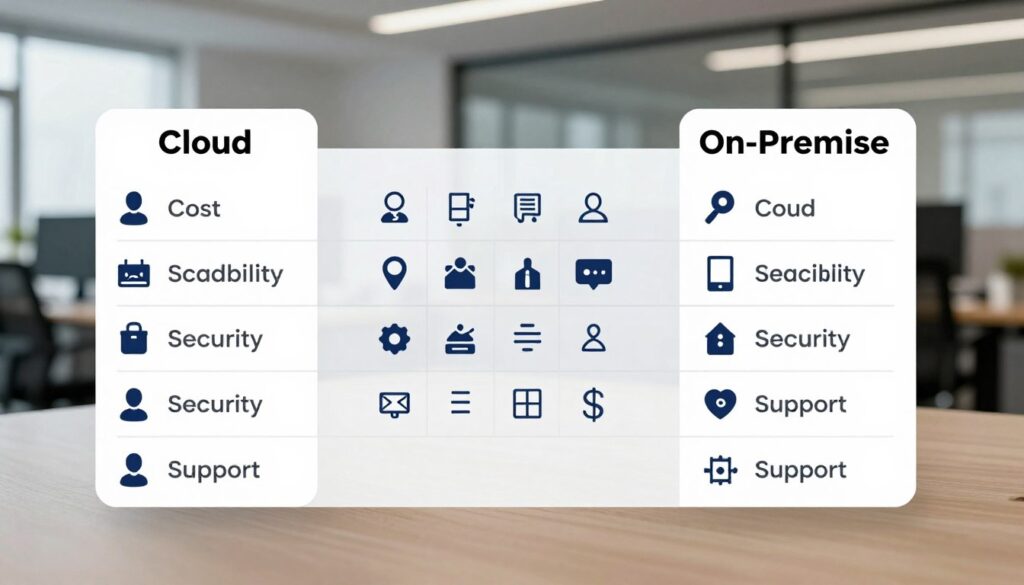
The financial models create different cash flow implications. Subscription services spread costs over time as operational expenses.
Traditional systems demand significant capital upfront. This affects budgeting and available resources for other initiatives.
Scalability represents a major operational difference. Modern solutions adjust instantly to seasonal demand or business growth.
Legacy infrastructure requires planning cycles for expansion. Adding capacity involves procurement delays and installation lead times.
Implementation speed varies dramatically. Teams can begin using new tools within days with subscription offerings.
Traditional deployments involve lengthy vendor negotiations. Physical installation and configuration add further delays.
Maintenance responsibility shifts operational burden. Providers manage infrastructure, security patches, and performance optimization.
Internal teams bear full responsibility with owned systems. This requires specialized skills and constant attention.
Feature innovation follows different paths. Modern tools receive automatic updates with AI and omnichannel capabilities.
Traditional solutions remain static between major upgrades. Businesses miss emerging technologies without additional investment.
Security approaches reflect different philosophies. Provider-managed solutions offer certified, enterprise-grade protection.
Some organizations prefer complete internal data control. This satisfies specific regulatory or compliance requirements.
Business continuity planning differs substantially. Built-in redundancy supports automatic failover during disruptions.
Owned systems require duplicate infrastructure investments. Companies must design and test their own recovery procedures.
Integration capabilities affect system connectivity. API-first designs connect easily with CRM and business tools.
Legacy integrations often need custom development work. This increases complexity and maintenance requirements.
Startups and small businesses typically favor subscription models. The lower initial cost and rapid deployment support growth.
Some regulated enterprises may prefer owned solutions. Specific control needs or existing investments influence this choice.
The comparison highlights trade-offs between flexibility and control. Each organization must evaluate its unique priorities.
Breaking Down the Cost: Initial Investment and Ongoing Expenses
Budgeting for customer support technology involves navigating two fundamentally different financial models with distinct cash flow implications. The choice between these approaches affects your balance sheet, operational flexibility, and long-term financial health.
This section provides a detailed financial analysis. We examine both immediate investments and recurring operational costs. You will see how each model impacts your organization’s resources over time.
On-Premise: Capital Expenditure (CapEx) Model
Traditional systems follow a capital expenditure approach. This requires significant upfront investment before operations can begin. Companies purchase all hardware and software licenses outright.
Initial costs include specialized servers, PBX equipment, and physical phones. Implementation services and configuration add substantial expenses. These investments often range from $50,000 to $500,000 depending on organizational size.
Per-agent seat expenses typically fall between $2,000 and $5,000. This covers dedicated hardware and individual software access. The total quickly escalates with team expansion.
Ongoing expenses create continuous financial burdens. Annual maintenance fees represent 15-25% of original license costs. Internal IT staff must manage the infrastructure full-time.
Hardware repairs and replacements occur regularly. Telephony line charges accumulate monthly. Major upgrade projects happen every few years with additional costs.

Cloud-Based: Operational Expenditure (OpEx) Model
Modern solutions use an operational expenditure framework. Businesses pay predictable subscription fees instead of large capital outlays. This preserves cash for other strategic investments.
Monthly costs typically range from $65 to $250 per agent. The exact amount depends on your chosen provider and feature package. This includes all infrastructure and maintenance responsibilities.
Subscription components break down clearly. A base platform fee covers core functionality. Per-user charges apply for each team member accessing the system.
Add-on modules enable advanced capabilities like analytics and workforce management. Some providers include usage-based pricing for high interaction volumes. This creates transparent, scalable cost structures.
Financial planning becomes simpler with this model. Expenses align directly with operational needs and team size. There are no surprise hardware failures or upgrade projects.
Hidden Costs and Total Cost of Ownership (TCO)
Both approaches include expenses beyond obvious line items. Understanding these hidden factors reveals the true financial picture. Total cost of ownership analysis over 3-5 years provides clarity.
Traditional systems incur facility-related expenses. Power and cooling for server rooms add utility costs. Physical security measures protect expensive equipment.
The opportunity cost of IT focus represents another hidden expense. Technical staff spend time maintaining infrastructure instead of improving customer experiences. This indirect cost affects organizational efficiency.
Subscription models have different hidden considerations. Overage charges may apply during peak seasonal volumes. Customization and training sometimes involve additional fees.
Calculating TCO requires including all direct and indirect expenses. Despite higher recurring fees, modern solutions often show lower total costs. This results from eliminating hardware depreciation and reducing IT overhead.
| Cost Category | Traditional CapEx Model | Modern OpEx Model |
|---|---|---|
| Initial Investment | $50,000-$500,000 + $2,000-$5,000/agent | Minimal setup fees |
| Monthly Recurring | Maintenance fees + IT staff + telephony | $65-$250/agent subscription |
| Hidden Expenses | Power/cooling, physical security, upgrade projects | Potential overages, customization, training |
| 3-Year TCO (50 agents) | $750,000-$1,200,000 (estimated) | $117,000-$450,000 (estimated) |
| Financial Impact | Capital intensive, affects balance sheet | Operational, preserves capital |
A comprehensive TCO framework includes several key factors. Depreciation schedules affect asset valuation over time. Staff hours dedicated to system management represent real costs.
Downtime expenses impact customer satisfaction and revenue. Innovation lag creates competitive disadvantages. Scalability expenses during growth periods affect both models differently.
Capital expenditure affects corporate balance sheets directly. These investments require formal budget approvals and multi-year depreciation. They tie up resources that could fund other initiatives.
Operational expenditure simplifies financial planning. Monthly subscriptions align costs with usage and business cycles. This approach preserves capital for strategic growth investments.
Calculating TCO for your specific situation requires careful analysis. Consider your expected growth rate and seasonal patterns. Evaluate your internal technical capabilities and resource availability.
The true value of modern solutions extends beyond direct cost savings. Agility during market changes provides competitive advantages. Continuous innovation access keeps your team equipped with current tools.
This financial analysis provides a foundation for informed decision-making. Combine these cost considerations with operational needs and strategic goals. The right choice balances immediate expenses with long-term value creation.
Key Benefits of Adopting Cloud Based Call Center Platforms
The operational advantages of modern communication solutions extend far beyond simple cost savings. These hosted tools transform how businesses manage the complete customer engagement lifecycle. From hiring staff to handling complex inquiries, every operational phase benefits.

Internet-hosted services deliver strategic improvements across multiple dimensions. They enhance team productivity while improving customer satisfaction metrics. The following benefits represent the most significant value drivers for organizations making this transition.
Scalability and Flexibility
Modern solutions offer elastic capacity that adjusts to business needs instantly. Managers can add or remove agent seats with just a few clicks. This happens without hardware procurement delays or complex installation processes.
Seasonal demand spikes become manageable rather than problematic. Businesses grow their communication channels alongside their teams. Video and social messaging integrate seamlessly as customer preferences evolve.
Remote and hybrid workforces operate with full functionality. All team members access the same tools regardless of location. This geographic flexibility supports talent acquisition and retention strategies.
Workflow adaptation happens quickly when market conditions change. Customer expectations shift constantly in today’s digital landscape. Agile organizations modify their processes to stay competitive.
Rapid Deployment and Updates
Implementation timelines shrink from months to days or weeks. Technical resource requirements minimize during setup. Pre-configured best practices accelerate the onboarding process.
New teams become operational almost immediately after subscription. There’s no waiting for equipment shipments or vendor installations. Minimal internal IT involvement speeds the transition.
Continuous innovation arrives automatically through regular updates. Providers deliver new features, security patches, and AI capabilities regularly. Subscribers gain these enhancements without disruptive upgrade projects.
Additional costs rarely apply for these ongoing improvements. The subscription model includes access to the latest technology. Businesses maintain competitive advantages through constant innovation.
| Benefit Category | Operational Impact | Business Value |
|---|---|---|
| Elastic Scaling | Instant seat adjustment, feature expansion | Cost control during fluctuations, growth support |
| Workforce Flexibility | Remote access, distributed teams | Talent pool expansion, continuity assurance |
| Rapid Implementation | Days/weeks deployment, minimal IT needs | Faster ROI, quicker market response |
| Automatic Innovation | Continuous updates, new capabilities | Competitive edge, future-proof operations |
| Business Continuity | Geographic redundancy, anywhere access | Risk reduction, service reliability |
Built-in Disaster Recovery and Business Continuity
Enterprise-grade solutions provide geographic redundancy across multiple regions. Data backups occur automatically without manual intervention. Automatic failover mechanisms activate during service disruptions.
Natural disasters or facility issues don’t interrupt customer service. Agents continue working from any location with internet access. The COVID-19 pandemic demonstrated this capability’s critical importance.
Organizations pivoted successfully when physical offices closed. Service levels maintained consistency despite unprecedented challenges. This resilience represents a fundamental advantage over traditional systems.
Provider-managed infrastructure reduces internal IT burdens significantly. Security updates, compliance requirements, and performance optimization happen automatically. Internal teams focus on strategic initiatives rather than maintenance tasks.
These hosted tools streamline the complete operating lifecycle. They enhance hiring processes and staff training programs. Intelligent routing connects customers with the most qualified representatives.
Performance monitoring happens through real-time analytics dashboards. Managers gain insights into team efficiency and customer satisfaction. Every interaction contributes to continuous improvement.
Advantages of Staying with On-Premise Solutions
While modern subscription services dominate conversations, traditional on-premise systems retain compelling advantages for specific organizational needs. These benefits often center around control, customization, and specialized requirements that external providers cannot fully address.
For certain industries and business models, owning the complete infrastructure delivers strategic value. This approach aligns with long-established operational philosophies and compliance frameworks.
The decision involves weighing tangible benefits against the agility trade-offs discussed earlier. Organizations must evaluate whether these advantages justify the associated management burdens.
Complete Control and Customization
Businesses maintain absolute authority over every component of their communication infrastructure. This ownership enables deep customization of workflows, integrations, and user interfaces.
Teams can tailor systems to match unique operational processes precisely. Modifications occur at the code level for specialized industries like finance and healthcare.
These organizations often work with proprietary requirements that standardized solutions cannot address. Custom development integrates seamlessly with legacy enterprise software.

Performance predictability represents another significant advantage. Dedicated hardware ensures consistent call quality and minimal latency.
There is no dependency on internet bandwidth or shared resources. This reliability supports critical customer interactions where consistency matters most.
Long-term cost structures become more predictable after the initial investment. Stable organizations without frequent scaling needs may experience lower ongoing expenses.
Integration capabilities extend to older enterprise systems through direct database connections. Custom APIs bridge gaps with software lacking modern integration features.
| Control Advantage | Operational Impact | Ideal For |
|---|---|---|
| Full Infrastructure Ownership | Complete management of all hardware and software components | Organizations with specialized technical teams |
| Deep Customization | Code-level modifications for unique workflows and compliance | Finance, healthcare, government sectors |
| Performance Consistency | Predictable call quality without internet dependency | Businesses with critical voice communication needs |
| Legacy Integration | Direct connections with older enterprise software systems | Companies with substantial existing technology investments |
| Vendor Independence | No risk of provider price changes or service discontinuation | Organizations prioritizing long-term stability |
Perceived Security and Data Governance
Many organizations view keeping information within their corporate firewall as inherently safer. This perception appeals particularly to defense, intelligence, and other sensitive sectors.
Data never leaves company-controlled environments under this model. Localization laws in certain regions may explicitly require this approach.
Complete ownership of the data lifecycle enables precise governance. Companies establish retention policies, access logs, and audit trails without third-party involvement.
Regulatory compliance sometimes becomes more straightforward with physical control. Certain regulations may make external provider compliance complex despite certifications.
Internal teams manage every aspect of security protocols and access controls. This hands-on approach satisfies organizations with extreme sensitivity requirements.
The management burden increases significantly with this level of control. Technical staff must handle updates, patches, and security monitoring continuously.
These advantages come with significant trade-offs that organizations must carefully weigh. The lack of automatic innovation access creates technology gaps over time.
Management burdens consume internal resources that could focus on customer experience improvements. Scalability limitations affect growth potential during demand spikes.
Each business must evaluate whether control benefits outweigh agility constraints. The right choice depends on specific industry requirements and strategic priorities.
Feature Showdown: Capabilities of Modern Platforms
The evolution from voice-only systems to comprehensive engagement hubs represents a fundamental shift in customer service technology. Today’s solutions offer integrated capabilities that transform how businesses connect with their audience.
These tools move beyond basic telephony to create seamless customer journeys. They incorporate intelligence and automation throughout the interaction process.
Omnichannel Support vs. Voice-Only
A key distinction separates basic telephony tools from comprehensive engagement solutions. Traditional systems often focus exclusively on voice communication.
Modern platforms unify multiple channels within a single interface. Customers can connect through their preferred method without friction.
This includes email, website chat, SMS, social media, and video conferencing. Agents see the complete conversation history across all touchpoints.
The difference is clear between voice-only and true omnichannel functionality. Legacy setups create silos where information gets trapped in separate systems.
Contemporary solutions break down these barriers. They provide a unified view of each customer’s journey.
AI and Automation Integration
Artificial intelligence transforms routine interactions into intelligent conversations. Natural language processing detects customer intent during chats and calls.
Sentiment analysis monitors emotional tones in real-time. This helps agents adjust their approach during challenging conversations.
Conversational AI powers virtual agents that handle common inquiries. These digital assistants provide instant responses to frequently asked questions.
Predictive routing matches customers with the best-fit representatives. The system analyzes agent skills, availability, and historical performance.
Robotic process automation handles after-call work automatically. It updates CRM records and completes necessary documentation.
AI-powered self-service bots resolve issues without human intervention. Automated quality assurance monitors interactions for coaching opportunities.
Workflow automation reduces manual tasks throughout the engagement process. This significantly improves agent efficiency and satisfaction.
Analytics and Reporting Depth
Comprehensive analytics provide unprecedented visibility into operations. Real-time dashboards show current performance metrics across teams.
Historical reporting tracks trends over weeks, months, and years. Managers identify patterns in customer behavior and agent performance.
Speech analytics transcribes and analyzes 100% of voice conversations. This technology uncovers insights that manual review would miss.
Predictive analytics forecast contact volume and resource needs. These tools help with workforce planning and scheduling optimization.
Traditional systems typically offer basic reporting with limited depth. They struggle to provide actionable intelligence for improvement.
Modern solutions embed advanced analytics throughout their architecture. Machine learning algorithms continuously refine their recommendations.
| Feature Category | Modern Subscription Solutions | Traditional On-Premise Systems | Availability Level |
|---|---|---|---|
| Omnichannel Support | Unified voice, email, chat, SMS, social, video | Primarily voice-only, separate channel systems | Standard in modern, limited in traditional |
| AI-Powered Routing | Predictive matching based on intent and skills | Basic rules-based or round-robin distribution | Premium in modern, unavailable in traditional |
| Virtual Agents | Conversational AI for self-service and triage | Basic interactive voice response (IVR) only | Premium in modern, unavailable in traditional |
| Real-Time Analytics | Live dashboards with customizable metrics | Limited to basic call volume and duration | Standard in modern, basic in traditional |
| Speech Analytics | 100% call transcription and sentiment analysis | Manual sampling (1-2% typically reviewed) | Premium in modern, unavailable in traditional |
| Workflow Automation | RPA for after-call work and process automation | Manual processes requiring agent input | Premium in modern, unavailable in traditional |
| Integration Ecosystem | Pre-built connectors with CRM and business tools | Custom development required for most integrations | Standard in modern, custom in traditional |
| Continuous Updates | Automatic feature releases and security patches | Major upgrade projects every 3-5 years | Standard in modern, project-based in traditional |
Specific AI capabilities demonstrate this technological advancement. Five9 offers intelligent chatbots that handle complex customer inquiries.
Replicant’s “Thinking Machine” automates entire conversation flows. It understands context and maintains coherent dialogue across exchanges.
AmplifAI provides personalized performance coaching for representatives. It analyzes interactions to identify specific improvement opportunities.
Observe.AI delivers comprehensive speech analytics with real-time guidance. The platform offers instant suggestions during customer conversations.
The innovation pace differs dramatically between deployment models. Subscription solutions continuously add new capabilities.
Recent advancements include generative AI for agent assistance. Emotion detection algorithms help representatives manage difficult situations.
Automated coaching systems provide immediate feedback after each interaction. These features arrive automatically through regular updates.
Traditional systems remain static between major upgrade projects. Businesses using these solutions miss emerging technologies.
Integration ecosystems represent another significant advantage. Modern tools offer pre-built connectors with popular business applications.
These include CRM platforms like Salesforce and Microsoft Dynamics. Help desk software and business intelligence tools connect seamlessly.
The API-first architecture enables straightforward customization. Developers can extend functionality without complex workarounds.
This comprehensive feature comparison highlights the capability gap. Modern solutions provide tools that transform customer engagement.
They turn routine interactions into opportunities for relationship building. The right platform becomes a strategic asset for business growth.
Calculating ROI: Measuring the True Value of Your Investment
A comprehensive ROI calculation framework transforms technology decisions from budget exercises to strategic business planning. This approach reveals the complete financial picture behind your communication infrastructure.
True value measurement examines both direct savings and indirect benefits. It connects technology costs to business outcomes like customer retention and revenue growth.
The framework includes quantitative and qualitative factors. Financial metrics show immediate cost reductions. Operational improvements demonstrate long-term strategic advantages.
Quantitative analysis covers hard dollar savings from reduced IT expenses. It also measures productivity gains through automation and better routing.
Qualitative assessment evaluates customer satisfaction improvements. Agent retention rates and innovation access contribute to competitive positioning.
This holistic view ensures you capture the full impact of your investment. Both deployment models offer distinct value propositions that require careful evaluation.
Factors in Cloud Platform ROI
Internet-hosted solutions deliver ROI through multiple interconnected channels. The subscription model creates predictable financial outcomes with faster time-to-value.
Reduced IT staffing costs represent a significant saving. Businesses eliminate dedicated infrastructure management teams. Technical resources focus on strategic initiatives instead of maintenance.
Hardware refresh cycles disappear entirely. There are no capital expenditures for server replacements every 3-5 years. The provider handles all infrastructure upgrades automatically.
Rapid deployment accelerates value realization. Teams become operational within days rather than months. This faster implementation translates to quicker productivity improvements.
Scalability prevents costly over-provisioning. Companies pay only for the capacity they actually use. Seasonal demand spikes don’t require permanent infrastructure investments.
Continuous feature updates arrive without additional projects. New capabilities like AI and omnichannel routing enhance performance constantly. Businesses maintain competitive advantages through automatic innovation.
| ROI Factor | Quantitative Impact | Business Outcome |
|---|---|---|
| IT Staff Reduction | 30-50% lower technical support costs | Resources redirected to customer experience improvements |
| Hardware Elimination | $15,000-$50,000 savings per server refresh cycle | Capital preserved for growth initiatives |
| Power & Cooling Savings | $5,000-$20,000 annual utility cost reduction | Improved operational efficiency and sustainability |
| Productivity Gains | 20-35% improvement in agent handling efficiency | Higher customer satisfaction and reduced labor costs |
| Downtime Reduction | 99.9%+ uptime versus 95-97% with traditional systems | Consistent service delivery and revenue protection |
AI automation handles 30-50% of routine customer inquiries. Virtual agents resolve common questions without human intervention. This frees your team for complex, high-value conversations.
Omnichannel routing reduces average handle times by 15-25%. Intelligent distribution connects customers with the right representatives faster. First contact resolution rates improve significantly.
Advanced analytics provide actionable insights for continuous improvement. Real-time dashboards help managers optimize team performance. Predictive tools forecast demand and resource needs accurately.
The subscription model versus capital depreciation creates favorable cash flow. Monthly payments align with operational budgets. There’s no large upfront investment affecting balance sheets.
Power and cooling savings from eliminated server rooms add up quickly. Physical security costs for equipment protection disappear entirely. Facility space becomes available for revenue-generating activities.
Reduced downtime from provider-managed infrastructure protects revenue streams. Geographic redundancy ensures business continuity during disruptions. Service level agreements guarantee performance standards.
Factors in On-Premise Platform ROI
Traditional systems offer ROI through different value drivers. Complete control and customization create efficiencies for specific organizational needs.
Long-term cost stability emerges after the initial amortization period. Once hardware is fully depreciated, ongoing expenses become predictable. Stable organizations without frequent scaling needs benefit most.
Customization efficiency supports unique business processes. Deep tailoring matches workflows precisely to operational requirements. This reduces training time and improves agent proficiency.
Data control minimizes compliance costs for regulated industries. Keeping information within corporate firewalls satisfies strict regulatory requirements. Audit trails and access logs remain entirely internal.
Performance predictability ensures consistent service quality. Dedicated hardware eliminates dependency on internet bandwidth fluctuations. Voice communication maintains clarity during critical interactions.
Vendor independence prevents unexpected price increases. Businesses avoid provider fee changes or service discontinuation risks. Long-term planning becomes more reliable without external dependencies.
ROI timelines differ dramatically between deployment models. Internet-based solutions deliver faster returns through operational efficiencies.
Most businesses see positive ROI within 6-12 months of implementation. Rapid deployment and immediate productivity gains accelerate value realization. Cost savings from eliminated infrastructure become apparent quickly.
Traditional systems may show better long-term ROI over 5+ years for stable deployments. Large organizations with predictable growth patterns benefit from amortized investments. Customization efficiencies compound over extended periods.
Intangible benefits significantly influence total value calculations. Business agility enables new revenue opportunities through faster market response.
Innovation access keeps pace with evolving customer expectations. Automatic updates ensure teams always have current tools. This maintains competitive positioning in dynamic markets.
Remote work support attracts and retains top talent. Geographic flexibility expands the available workforce pool. Distributed teams operate with full functionality regardless of location.
| Time Horizon | Internet-Based Solutions | Traditional Systems |
|---|---|---|
| 6-12 Months | Positive ROI from rapid deployment and IT savings | Negative ROI due to high initial capital investment |
| 1-3 Years | Strong ROI from productivity gains and scalability | Break-even point as hardware amortizes |
| 3-5 Years | Sustained ROI from continuous innovation access | Positive ROI from stable operational costs |
| 5+ Years | Compounding ROI from business agility advantages | Potentially higher ROI for stable, large-scale deployments |
ROI calculation templates help compare different scenarios. Worksheets for 3-year and 5-year total cost of ownership provide clarity.
Productivity metrics quantify efficiency improvements from better tools. Business outcome projections connect technology investments to revenue growth.
Industry-specific considerations influence value assessments. Regulated sectors may prioritize control over agility in their calculations.
Financial services value data governance and compliance assurance. Healthcare organizations prioritize patient information security above all else.
E-commerce businesses emphasize omnichannel capabilities and AI integration. Rapid scalability during peak seasons drives their ROI calculations.
Case studies demonstrate real-world ROI achievements. Many organizations report 20-40% operational cost reductions with modern solutions.
Customer satisfaction scores often improve by 30% or more. New agent ramp-up time decreases by 50% through better training tools.
First contact resolution rates increase significantly with intelligent routing. Average handle times drop as agents access complete customer histories instantly.
The true value of your investment emerges when you consider all these factors together. Both financial metrics and strategic advantages contribute to comprehensive ROI.
This analysis prepares you to make informed decisions about your communication infrastructure. The right choice balances immediate costs with long-term value creation for your specific business context.
The Market Shift: Why Cloud Contact Centers Are Dominating
Industry data reveals a decisive migration toward internet-hosted solutions, with adoption rates now surpassing traditional deployments. The contact center software industry has transformed significantly in recent years. New technologies like generative AI have opened opportunities for powerful innovations.
Current statistics show hosted communication tools exceeding 60% market penetration. This adoption grows at 15-20% annually while traditional installations decline. The shift represents more than just technological preference.
Several powerful forces drive this transformation. Businesses face pressure to modernize their customer service operations. The need for agility has become critical in today’s volatile market.
| Driving Factor | Impact on Adoption | Business Outcome |
|---|---|---|
| Digital Transformation Initiatives | Accelerates migration from legacy systems to modern tools | Improved operational efficiency and competitive positioning |
| Remote/Hybrid Work Trends | Enables distributed teams with full functionality | Expanded talent pools and business continuity |
| Omnichannel Customer Expectations | Demands unified communication across all touchpoints | Higher satisfaction scores and loyalty rates |
| Post-Pandemic Business Agility | Requires rapid adaptation to changing market conditions | Faster response to opportunities and threats |
Technology itself acts as a powerful catalyst for change. Artificial intelligence and automation make these solutions increasingly intelligent. Major technology companies have entered the space with integrated ecosystems.
Hyperscalers like Amazon, Google, and Microsoft leverage their command of adjacent markets. They aim to claim significant portions of the contact center software ecosystem. Their entry validates the strategic importance of this transformation.
Generative AI represents a particularly transformative development. It enables developers to add innovative features previously unimaginable. Virtual agents now handle complex conversations with human-like understanding.
Economic considerations further accelerate the shift. The operational expenditure model appeals in uncertain climates. It reduces capital requirements while aligning costs with business activity.
Companies preserve cash for strategic investments rather than infrastructure. Monthly subscriptions provide predictable budgeting during volatility. This financial flexibility proves invaluable for growth-focused organizations.
Innovation velocity differs dramatically between deployment models. Hosted providers deliver new capabilities quarterly through automatic updates. These include AI agents, advanced analytics, and seamless integrations.
Traditional systems require major upgrade projects every few years. Businesses using older solutions miss emerging technologies between cycles. The innovation gap widens with each passing quarter.
Talent dynamics also influence this market shift. Modern tools with intuitive interfaces attract younger professionals. These individuals expect consumer-grade technology in their workplace.
AI assistance helps representatives perform better from their first day. Real-time guidance during challenging conversations reduces stress. This improves retention rates in an industry with high turnover.
Scalability has become a business imperative rather than a luxury. Organizations need to handle volatility in interaction volumes effectively. Elastic capacity proves more valuable than fixed infrastructure.
Seasonal spikes no longer require permanent hardware investments. Businesses scale up or down with a few clicks. This operational flexibility supports sustainable growth patterns.
Industry convergence creates additional momentum. Contact Center as a Service (CCaaS) now blends with Unified Communications (UCaaS). These integrated environments connect seamlessly with CRM platforms.
This comprehensive approach was only feasible with internet-hosted architecture. It breaks down silos between different communication functions. Customers experience truly unified service across all channels.
Future trends will further accelerate this dominance. Complete AI-driven automation will handle routine inquiries without human intervention. Predictive customer engagement will anticipate needs before they’re expressed.
Immersive experiences using augmented and virtual reality will emerge. These technologies will transform how support teams assist customers. The innovation cycle shows no signs of slowing.
The market shift represents a fundamental reconfiguration of customer engagement. Businesses that embrace this transformation gain significant advantages. They achieve better efficiency, flexibility, and customer satisfaction.
This evolution continues as technology advances and expectations rise. The trajectory points toward increasingly intelligent, integrated solutions. Organizations must position themselves for this ongoing transformation.
Product Roundup: Top Cloud-Based Platforms for SMBs and Startups
Startups and SMBs need solutions that deliver immediate value without complex implementation or excessive costs. This roundup highlights tools specifically designed for growing businesses. They balance affordability with powerful features.
These options help small teams compete with larger organizations. They provide professional customer interactions on limited budgets. Rapid return on investment is a key requirement.
Nextiva: All-in-One Communication and CX
Nextiva helps small and mid-sized businesses manage customer interactions in one place. Many SMBs struggle with fragmented tools for different functions. This software integrates communication and workflow management.
It simplifies staying organized and responding quickly. The system improves overall customer experience through consolidation. Teams access everything from a single interface.
Five key features define Nextiva’s approach. Intelligent call management ensures proper routing. A built-in CRM provides essential customer context.
AI-powered automation handles routine tasks efficiently. Reliable VoIP technology delivers clear voice conversations. SMS capabilities support text-based engagement.
The pricing model suits tight budgets perfectly. Plans range from $20 to $40 per user monthly. This includes most features businesses need daily.
Nextiva eliminates the tool fragmentation common in growing companies. Operations simplify with a single vendor relationship. The system scales smoothly from startup to mid-market growth.
CloudTalk: Automation and Analytics Focus
CloudTalk specializes in automation and deep analytics. It streamlines contact center performance for better efficiency. The software increases operational effectiveness through smart features.
Innovative AI capabilities include topic extraction. This automatically monitors conversational themes across interactions. Managers gain insights without manual review.
Advanced analytics provide real-time performance visibility. Dashboards display key metrics for quick analysis. Call recording analytics uncover patterns and opportunities.
Integration with business intelligence tools extends capabilities. Data flows seamlessly into reporting systems. This supports informed decision-making.
CloudTalk uses a modular pricing approach. Businesses pay only for the features they actually need. This flexibility helps control costs during early growth stages.
| Comparison Factor | Nextiva | CloudTalk |
|---|---|---|
| Primary Focus | Unified communications and customer experience | Automation and performance analytics |
| Pricing Model | All-inclusive bundles ($20-$40/user/month) | Modular, pay-for-what-you-need approach |
| Key Strength | Integration of calling, CRM, and team messaging | AI-powered topic extraction and analytics |
| Implementation | Guided setup with pre-built templates | Quick configuration for immediate use |
| Ideal For | Businesses wanting simplicity and consolidation | Teams prioritizing data-driven optimization |
| Scalability Range | 5 to 500+ agents | 10 to 300+ agents |
| SMB Tool Integration | QuickBooks, G Suite, Shopify | Zapier, Salesforce, HubSpot |
Both platforms design for quick implementation. They require minimal IT resources for setup. Pre-built templates and guided configuration accelerate deployment.
These solutions address specific SMB needs effectively. Affordability matches limited budgets without sacrificing capability. Simplicity ensures teams adopt the tools quickly.
Scalability supports growth from small teams to hundreds of agents. Integration with common business tools reduces friction. QuickBooks, Shopify, and G Suite connect seamlessly.
Selection guidance depends on your primary goals. Nextiva suits businesses wanting unified communications. It combines customer experience management with internal collaboration.
CloudTalk fits organizations prioritizing analytics and process automation. Its data-focused approach helps optimize operations. The modular pricing appeals to cost-conscious teams.
These internet-hosted solutions represent the modern approach for growing companies. They deliver enterprise-grade capabilities at SMB prices. The right choice depends on your specific operational needs.
Product Roundup: Enterprise-Grade Cloud Contact Center Solutions
Enterprise-grade contact solutions distinguish themselves through advanced security protocols, deep integrations, and artificial intelligence at massive scale. These tools serve large organizations with complex operational requirements.
They support deployments spanning thousands of representatives across global regions. The software must handle immense interaction volumes while maintaining exceptional quality.
This roundup examines three leading options for corporations. Each platform brings unique strengths to enterprise customer engagement.
Talkdesk: AI-Driven CX at Scale
Talkdesk targets large, high-volume environments needing advanced artificial intelligence. The platform delivers seamless customer experiences through sophisticated automation.
Its AI-powered approach includes Talkdesk Autopilot for generative virtual agents. These digital assistants handle complex dialogues with human-like understanding.
Intelligent routing matches customers with the best-fit representatives. Real-time assistance guides agents during challenging conversations.
Predictive analytics forecast customer needs before they’re expressed. This proactive approach transforms reactive support into anticipatory service.
Five core features define Talkdesk’s enterprise offering. Automatic distribution ensures efficient handling of incoming contacts.
Omnichannel support unifies voice, email, chat, and social messaging. Speech analytics provide quality management across all interactions.
Workforce engagement tools optimize team performance and satisfaction. Enterprise-grade security meets the strictest compliance requirements.
Five9: Security-Focused CCaaS
Five9 provides a fully hosted contact center platform with exceptional security emphasis. Businesses concerned with sensitive customer data find this approach appealing.
The platform meets strict compliance mandates for regulated industries. Financial services, healthcare, and government sectors benefit from these controls.
Compliance certifications include PCI DSS, HIPAA, and SOC 2. Data encryption protects information throughout the engagement lifecycle.
Comprehensive audit trails document every access and action. Security controls satisfy even the most rigorous organizational requirements.
AI capabilities enhance the customer experience without compromising safety. Powered chatbots handle routine inquiries efficiently.
Virtual agents resolve common issues without human intervention. CRM integration provides context-aware interactions across all channels.
The system maintains transparency while delivering robust protection. This balance makes Five9 ideal for security-conscious enterprises.
NICE inContact: Predictive and Conversational AI
NICE inContact combines predictive and conversational artificial intelligence for personalized experiences. The platform analyzes historical data to forecast customer needs.
It routes interactions optimally before customers articulate their requests. This anticipatory approach reduces handling time and improves satisfaction.
Conversational AI services train on actual agent conversations. The system learns from human dialogues to handle complex exchanges.
Real-time coaching helps representatives during live interactions. Generative features identify opportunities for better personalization.
The platform’s predictive capabilities extend beyond basic forecasting. It anticipates customer emotions and potential escalation points.
This allows for proactive intervention before situations deteriorate. The result is smoother resolutions and stronger relationships.
| Solution | Primary Strength | AI Capabilities | Ideal Industries | Security Focus |
|---|---|---|---|---|
| Talkdesk | AI-driven customer experience at scale | Generative virtual agents, predictive routing, real-time assistance | Retail, technology, high-volume B2C | Enterprise-grade with comprehensive compliance |
| Five9 | Security and compliance emphasis | AI chatbots, virtual agents, context-aware interactions | Financial services, healthcare, government | PCI DSS, HIPAA, SOC 2 certified with full encryption |
| NICE inContact | Predictive and conversational AI | Forecasting customer needs, conversational AI trained on agent dialogues | Telecommunications, utilities, insurance | Robust with focus on data analysis security |
All three solutions support global deployments with regional data centers. They offer 99.99% uptime service level agreements for reliability.
Capacity scales to tens of thousands of concurrent representatives. This meets the demands of multinational corporations.
Integration depth distinguishes these enterprise platforms. Pre-built connectors link with major CRM systems like Salesforce and Microsoft Dynamics.
ERP connections and custom API frameworks support legacy systems. This ensures seamless data flow across the organization.
Implementation complexity requires careful planning for large enterprises. Phased migration approaches prevent operational disruption.
Change management programs help teams adapt to new workflows. Professional services from vendors or partners often support deployment.
The right choice depends on your organization’s specific priorities. AI innovation, security compliance, or predictive capabilities may drive selection.
Each platform brings enterprise-grade robustness to customer engagement. They transform how large organizations deliver service experiences.
Product Roundup: Platforms Defined by AI and Innovation
The frontier of contact technology is defined by platforms that treat artificial intelligence not as an add-on but as their foundational architecture. These solutions represent the cutting edge where intelligence drives every interaction.
They move beyond basic automation to create truly intelligent systems. The focus shifts from features to cognitive capabilities that understand context and intent.
This roundup examines tools where AI serves as the core differentiator. Each takes a unique approach to embedding intelligence into customer conversations.
Dialpad: AI-Powered Voice and Virtual Agents
Dialpad stands out for its extensive investment in AI-based capabilities. The platform analyzes voice interactions with remarkable sophistication.
Its AI-driven voice analysis detects sentiment and keywords in real-time. This happens during live calls to provide immediate insights.
Automatic call summaries capture key discussion points without manual notes. Virtual agents conduct natural conversations using advanced language models.
Dialpad’s innovation stems from its origins as an internal communications tool. This background provides unique insights from business conversations across the entire organization.
The platform brings together voice intelligence with practical automation. It transforms routine inquiries into opportunities for deeper engagement.
Replicant: The Thinking Machine for Conversation Automation
Replicant introduces the “Thinking Machine” concept for handling repetitive interactions. AI agents manage these conversations across 30+ languages with full context awareness.
The system understands customer intent through natural language processing. It maintains coherent dialogue across multiple exchanges.
This approach significantly reduces agent burnout by automating routine inquiries. Team members focus on high-value customer conversations instead.
Replicant provides real-time coaching for human representatives during complex interactions. Conversation intelligence scores agents on empathy, clarity, and effectiveness.
The value extends beyond automation to performance improvement. Organizations gain both efficiency gains and quality enhancements.
Google Cloud Contact Center AI and Microsoft Dynamics 365
Google Cloud Contact Center AI leverages the company’s extensive AI research expertise. It focuses on sophisticated virtual agents integrated with Google’s ecosystem.
The solution connects with Workspace, Analytics, and Ads for comprehensive insights. Behind the scenes, Ujet powers the core contact center functionality.
Google’s AI layer adds advanced natural language capabilities on top. This creates a powerful combination of robust infrastructure and cutting-edge intelligence.
Microsoft Dynamics 365 Contact Center represents a fully in-house development released in June 2024. It emphasizes self-service on customer-preferred channels.
The platform provides monitoring and reporting capabilities designed to improve operational efficiency. Native integration with Dynamics CRM ensures seamless data flow.
Microsoft’s advantage lies in seamless integration with its broader ecosystem. Teams, Office 365, and Azure connect naturally for organizations standardized on Microsoft stack.
| Platform | Core AI Innovation | Primary Strength | Integration Ecosystem |
|---|---|---|---|
| Dialpad | Voice intelligence and real-time analysis | AI-powered sentiment detection and call summaries | Business communications and CRM systems |
| Replicant | Conversation automation across 30+ languages | The “Thinking Machine” for repetitive interactions | Existing contact infrastructure and quality systems |
| Google CC AI | Virtual agents leveraging Google’s AI research | Sophisticated natural language understanding | Google Workspace, Analytics, and advertising platforms |
| Microsoft D365 | Self-service and operational efficiency analytics | Seamless Microsoft ecosystem integration | Teams, Office 365, Azure, and Dynamics CRM |
These approaches represent different paths to innovation in customer engagement. Dialpad focuses on voice intelligence and real-time insights during conversations.
Replicant automates entire conversation flows with context-aware AI agents. Google applies its research expertise to create sophisticated virtual assistants.
Microsoft leverages its ecosystem advantage for seamless organizational integration. Each platform makes artificial intelligence central rather than peripheral.
The choice depends on your specific intelligence priorities and existing infrastructure. Voice analysis, conversation automation, research-powered AI, or ecosystem integration each offer distinct advantages.
These tools demonstrate how AI transforms from added feature to foundational architecture. They represent the next evolution in customer service technology.
Product Roundup: Specialized Tools for Workforce Optimization
The most successful contact operations don’t just deploy software—they build comprehensive ecosystems that optimize every aspect of agent performance. Core communication platforms handle customer interactions. Specialized workforce tools enhance the human element behind those conversations.
These solutions target the complete agent lifecycle. They improve hiring, training, scheduling, coaching, and performance management. The result is a more capable and motivated team.
This roundup examines leading tools in this specialized category. Each focuses on a different part of workforce optimization. Together, they create a powerful complement to any primary contact platform.
AmplifAI and Observe.AI for Agent Performance
AmplifAI delivers a performance management platform powered by artificial intelligence. It helps supervisors coach, train, and motivate their teams with data-driven insights. The system moves beyond generic training programs.
Personalized coaching targets each agent’s specific weaknesses. Gamification elements like leaderboards create healthy competition. Automated training programs adapt to individual learning needs.
Real-time feedback loops provide immediate guidance. The platform identifies skill gaps through detailed performance analytics. Managers then address these gaps with targeted interventions.
Observe.AI takes a different approach with speech analytics. Its AI-powered system monitors and analyzes customer conversations. The technology detects sentiment, keywords, and compliance issues automatically.
Real-time coaching helps agents during live interactions. Speech-to-text transcription makes every conversation searchable. This enables deep analysis of customer concerns and agent responses.
Quality assurance becomes automated and bias-free. The system scores agents by comparing them to top performers. This reduces manual review time while improving consistency across the team.
Playvox for Workforce Management
Playvox specializes in workforce management for contact operations. It helps organizations optimize agent schedules, forecast demand, and improve operational efficiency. The platform uses artificial intelligence to match staffing with needs.
Scheduling considers historical data, real-time demand, and individual agent skills. Forecasting tools predict interaction volumes with impressive accuracy. Shift optimization ensures the right people work at the right times.
Real-time alerts notify managers of emerging issues. The system prevents overstaffing during slow periods. It also avoids understaffing when customer demand spikes.
This balance reduces customer wait times significantly. It also prevents agent burnout from constant pressure. The result is better service experiences and healthier teams.
HiringBranch for Skills-Based Hiring
HiringBranch revolutionizes how contact centers recruit frontline staff. Its AI-driven assessments simulate real customer interactions. Applicants face written scenarios and simulated calls that test actual service skills.
The system analyzes job fit with remarkable precision. It identifies specific skill gaps during the evaluation process. Large companies use it to screen thousands of applicants efficiently.
HiringBranch achieves 98% accuracy in predicting successful hires. This data comes from actual deployment results. The innovation moves beyond resumes and multiple-choice tests.
Organizations assess genuine customer service abilities before hiring. This approach reduces turnover dramatically. It also improves the overall quality of new team members.
| Specialized Tool | Primary Focus | Key Capabilities | Integration Partners |
|---|---|---|---|
| AmplifAI | Performance Management & Coaching | AI-driven insights, personalized coaching, gamification, automated training | Five9, NICE, Talkdesk |
| Observe.AI | Speech Analytics & Quality Assurance | Sentiment analysis, compliance monitoring, real-time coaching, automated scoring | Five9, Genesys, Amazon Connect |
| Playvox | Workforce Management & Scheduling | AI-driven forecasting, shift optimization, real-time alerts, demand matching | Talkdesk, Zendesk, Salesforce |
| HiringBranch | Skills-Based Hiring & Assessment | Simulated interaction testing, job-fit analysis, skill gap identification | Major ATS platforms, enterprise HR systems |
These specialized tools typically integrate with leading contact platforms. They connect with solutions like Five9, NICE, and Talkdesk. This creates optimized workforce ecosystems without technical friction.
Data flows seamlessly between systems. Performance insights inform coaching programs. Scheduling data connects with actual interaction volumes.
The combination delivers exceptional operational efficiency. Organizations address every aspect of workforce management. They build teams that deliver outstanding customer experiences consistently.
Choosing the right specialized tools depends on your priorities. Performance coaching, quality assurance, scheduling, or hiring each represent different needs. Many successful operations implement multiple solutions together.
These tools demonstrate that technology serves human performance. The best contact centers leverage both platform capabilities and workforce optimization. This balanced approach drives sustainable excellence in customer service.
How to Choose: Evaluating Your Business Needs and Goals
A methodical assessment framework helps leaders match technology capabilities with organizational requirements for optimal outcomes. This systematic approach moves beyond vendor comparisons to focus on your unique operational reality.
The right choice depends on multiple interconnected factors. These include your company size, industry regulations, and growth trajectory. Technical resources and strategic objectives also play crucial roles.
This section provides a structured decision-making guide. It helps you evaluate both immediate needs and future aspirations. The goal is alignment between technology investments and business success.
Key Decision Criteria Checklist
Begin your evaluation with this comprehensive checklist. It covers operational, technical, financial, and strategic dimensions. Each category influences your final selection.
Operational Factors examine your daily workflow requirements. Current and future agent counts determine scalability needs. Geographic distribution affects infrastructure design.
Channel requirements range from voice-only to full omnichannel support. Integration needs with existing systems impact implementation complexity. Consider how each option supports your workflow.
Technical Considerations assess your internal capabilities. IT staff size and expertise determine management capacity. Existing infrastructure investments may influence migration costs.
Security and compliance requirements vary by industry. Bandwidth availability affects internet-hosted solution performance. Evaluate your technical readiness for each deployment model.
Financial Factors examine budget constraints and preferences. Capital versus operational expenditure models create different cash flow impacts. Total cost of ownership analysis reveals true expenses.
Budget limitations may favor subscription-based approaches. ROI expectations should align with implementation timelines. Consider both immediate costs and long-term value.
Strategic Goals connect technology to business outcomes. Digital transformation initiatives may prioritize modern solutions. Customer experience improvement targets influence feature selection.
Competitive differentiation needs affect innovation requirements. The desired pace of technological advancement guides update frequency preferences. Align your choice with broader organizational objectives.
| Decision Category | Key Questions to Ask | Evaluation Metrics |
|---|---|---|
| Operational Scale | How many agents work now? What growth is expected in 3-5 years? Are teams distributed geographically? | Current agent count, projected growth rate, location distribution |
| Channel Requirements | Do customers prefer voice, email, chat, or social media? Is omnichannel support necessary? | Channel usage patterns, customer preference data, integration needs |
| Technical Resources | What IT staff expertise exists? What legacy systems require integration? What security standards apply? | IT team size, existing infrastructure value, compliance certifications needed |
| Financial Framework | Is capital available for upfront investment? What operational budget exists? What ROI timeframe applies? | Available capital, monthly budget, expected payback period |
| Strategic Alignment | What customer experience improvements target? What innovation pace matches market position? What competitive advantages seek? | Customer satisfaction goals, technology adoption rate, differentiation requirements |
Internet-hosted solution suitability matches specific business profiles. Organizations with distributed or remote workforces benefit from anywhere access. Companies experiencing rapid growth appreciate elastic scaling.
Businesses needing the latest AI features value continuous updates. Those with limited IT resources prefer provider-managed infrastructure. Organizations desiring predictable costs favor subscription models.
Traditional on-premise suitability applies to different scenarios. Organizations with extreme security requirements maintain complete data control. Those with deep legacy system integration preserve existing investments.
Companies with stable, predictable volumes avoid scaling premiums. Organizations with available capital for upfront investment may prefer ownership. Some regulated industries mandate specific deployment approaches.
Hybrid options offer middle-ground solutions for some businesses. These models keep sensitive operations on-premise while using external services for scalability. Specific features like AI analytics might reside externally while core voice remains internal.
This approach balances control with innovation access. It requires careful architecture planning and integration management. The complexity increases but may satisfy competing requirements.
| Business Scenario | Primary Considerations | Recommended Approach | Key Rationale |
|---|---|---|---|
| 50-Agent SMB | Limited budget, rapid deployment, minimal IT staff, growth expected | Subscription-based solution | Lower initial cost, faster implementation, automatic updates support growth |
| 500-Agent Mid-Market | Multiple locations, omnichannel needs, integration with CRM, moderate IT resources | Enterprise-grade hosted platform | Scalability for expansion, unified customer view, balanced control and features |
| 5000-Agent Enterprise | Global operations, extreme security needs, legacy system integration, dedicated IT teams | Hybrid or traditional with careful evaluation | Control over sensitive data, integration with existing investments, geographic compliance |
| Regulated Industry | Strict compliance mandates, audit trail requirements, data localization laws, change control | Traditional or specialized hosted solution | Complete data governance, compliance documentation, controlled update cycles |
| High-Growth Startup | Limited capital, need for latest features, remote workforce, unpredictable volumes | Modern subscription service | Preserved cash for growth, access to innovation, workforce flexibility, elastic scaling |
Vendor evaluation criteria complete your assessment framework. Platform capabilities should match your feature requirements. Pricing transparency prevents unexpected expenses.
Implementation support affects deployment success. Customer service responsiveness ensures ongoing satisfaction. Roadmap alignment indicates future value.
Financial stability suggests long-term partnership viability. Reference checks with similar organizations provide real-world insights. Trial periods allow hands-on evaluation before commitment.
This structured approach transforms a complex decision into manageable steps. It ensures your technology investment supports business objectives effectively. The right choice emerges from thoughtful analysis rather than default preferences.
Implementation Considerations: Migration and Change Management
Transitioning your customer service infrastructure requires meticulous planning that addresses both technical migration and human adaptation. This dual focus ensures smooth adoption of new tools while maintaining operational continuity. The process involves detailed assessment, strategic execution, and ongoing optimization.
Effective migration begins with comprehensive current system analysis. Teams must inventory existing hardware, software, and data structures. This assessment identifies integration points and potential challenges early.
A phased rollout approach minimizes business disruption. Organizations typically start with non-critical teams or specific geographic regions. This allows for testing and adjustment before full deployment.
Integration mapping connects new solutions with existing business tools. Customer relationship management systems require particular attention. Seamless data flow between applications maintains service quality.
Technical Implementation Requirements
Network assessment ensures Voice over Internet Protocol quality meets standards. Bandwidth capacity must support expected conversation volumes. Latency and jitter measurements predict user experience.
Firewall configuration permits secure communication with external services. Session Initiation Protocol trunking setups replace traditional phone lines. These technical adjustments enable modern communication capabilities.
Testing protocols validate system functionality before live deployment. Teams conduct simulated customer interactions across all channels. Performance benchmarks confirm readiness for actual use.
Quality assurance checks identify potential issues early. Technical teams verify call clarity and connection stability. Integration testing ensures data synchronization between systems.
Data Migration Strategy
Transferring customer histories preserves valuable relationship context. Interaction records, purchase histories, and support tickets move to new environments. This continuity maintains service personalization.
Call recordings require format conversion for new platforms. Agent profiles with skill assessments and performance data need migration. Configuration settings like routing rules and business hours transfer systematically.
Validation processes confirm data accuracy after migration. Teams compare sample records between old and new systems. Data integrity checks identify discrepancies for correction.
Backup procedures protect information throughout the transition. Organizations maintain original data sources until verification completes. This safeguards against potential loss during transfer.
Organizational Change Management
Training programs prepare teams for new workflows and interfaces. Representatives learn navigation, features, and best practices. Supervisors gain monitoring and coaching capabilities.
Information technology staff receive technical administration training. This knowledge transfer ensures ongoing system management. Support personnel learn troubleshooting procedures.
Communication plans explain changes to all stakeholders. Regular updates share progress and address concerns. Transparent information flow reduces uncertainty and resistance.
Addressing workflow adaptation requires understanding current processes. New interfaces should simplify rather than complicate tasks. Familiar elements help teams transition smoothly.
| Implementation Phase | Typical Duration | Key Activities | Success Indicators |
|---|---|---|---|
| Planning & Assessment | 2-4 weeks | Current system inventory, requirements gathering, integration mapping | Complete documentation, stakeholder alignment, risk identification |
| Technical Preparation | 3-6 weeks | Network optimization, firewall configuration, SIP trunk setup | Quality testing passes, security compliance verified |
| Data Migration | 2-8 weeks | Customer history transfer, configuration migration, validation testing | Data accuracy confirmed, no business disruption |
| Pilot Deployment | 4-8 weeks | Limited team rollout, parallel system operation, feedback collection | User adoption metrics, performance benchmarks met |
| Full Deployment | 2-4 weeks | Organization-wide rollout, old system decommissioning | 100% transition completion, business continuity maintained |
| Optimization | Ongoing | Performance monitoring, feature enablement, process refinement | Efficiency improvements, customer satisfaction gains |
Timeline expectations vary significantly between deployment models. Internet-hosted implementations typically complete in 4-12 weeks. Traditional on-premise deployments often require 6-18 months.
Customization needs and data complexity affect project duration. Highly tailored solutions demand additional configuration time. Large historical datasets extend migration schedules.
Parallel running strategies operate old and new systems simultaneously. This approach ensures business continuity during transition. Agents gradually adapt to new interfaces while maintaining productivity.
Gradual adaptation reduces resistance to change. Teams build confidence with new tools over several weeks. Support resources address questions as they arise.
Post-Implementation Optimization
Performance monitoring begins immediately after deployment. Teams track handling times, resolution rates, and customer satisfaction. These metrics identify areas needing adjustment.
User feedback collection informs system refinement. Representatives share experiences with new workflows and features. This input guides interface improvements and training enhancements.
Routing rule tuning optimizes customer-agent matching. Analysis of initial interactions reveals patterns. Adjustments improve first-contact resolution and customer experience.
Advanced feature enablement occurs progressively. Teams master basic functionality before adding complex capabilities. This staged approach prevents overwhelm and ensures proper utilization.
Vendor Partnership Considerations
Selecting implementation partners requires evaluating expertise and experience. Providers with industry-specific knowledge deliver better outcomes. Reference checks confirm past performance.
Service level agreements define support expectations and response times. Escalation procedures establish communication channels for critical issues. These documents formalize the working relationship.
Ongoing support planning addresses post-deployment needs. Technical assistance, training resources, and system updates require coordination. Regular review meetings maintain partnership alignment.
Implementation methodology varies between providers. Some offer standardized approaches while others customize extensively. The chosen method should match organizational needs and culture.
Financial Considerations Beyond Software
Training costs include facilitator time, materials, and lost productivity during sessions. Comprehensive programs require investment but yield long-term benefits. Proper preparation reduces operational disruption.
Temporary productivity dips often occur during transition periods. Teams adapt to new interfaces and workflows. Planning for this reduction prevents service level impacts.
Consulting fees apply for complex migrations requiring external expertise. Specialized knowledge accelerates implementation and avoids pitfalls. These investments typically deliver positive returns.
Contingency budgeting addresses unexpected challenges during deployment. Unforeseen technical issues or data complications may arise. Reserve funds ensure project completion despite obstacles.
Success Measurement Framework
Key performance indicators track implementation effectiveness. Adoption rates measure how quickly teams embrace new tools. Handling time metrics show efficiency improvements.
Customer satisfaction scores reflect service quality maintenance. First-contact resolution rates indicate system effectiveness. These measurements validate transition success.
Agent feedback provides qualitative assessment of new workflows. Supervisor observations capture coaching and management experiences. Combined quantitative and qualitative data offers complete evaluation.
Regular progress reviews ensure continuous improvement. Monthly assessments identify optimization opportunities. Adjustment cycles refine system configuration and team processes.
Implementation success ultimately shows in business outcomes. Improved customer experiences drive loyalty and revenue. Enhanced agent efficiency reduces operational costs. These combined benefits justify the migration investment.
Conclusion: Making the Strategic Choice for Your Business
Your customer service infrastructure decision shapes competitive advantage for years to come. This analysis reveals clear pathways forward.
Internet-hosted solutions dominate for most organizations. They deliver superior agility, innovation access, and lower total costs. Traditional systems retain value for specific control or security needs.
The choice impacts customer experience and operational efficiency. Evaluate your business size, growth trajectory, and technical capabilities. Calculate three-to-five-year costs for both models.
Consider running trials with shortlisted providers. Ensure your solution accommodates evolving preferences and AI advancements.
In today’s dynamic environment, subscription services offer compelling advantages. They transform customer engagement into sustainable business growth.